Table of Contents
1. Introduction
Recovering scene illumination from a single image is a fundamental yet ill-posed problem in computer vision, crucial for applications like augmented reality (AR), image-based rendering, and scene understanding. The paper "Deep Outdoor Illumination Estimation" addresses this challenge specifically for outdoor scenes by proposing a Convolutional Neural Network (CNN) based method to predict High Dynamic Range (HDR) outdoor illumination from a single Low Dynamic Range (LDR) image. The core innovation lies in bypassing the need for direct HDR environment map capture by leveraging a large dataset of LDR panoramas and a physically-based sky model to generate a synthetic training dataset of image-illumination parameter pairs.
2. Methodology
The proposed pipeline consists of two main stages: dataset preparation and CNN training/inference.
2.1. Dataset Creation & Sky Model Fitting
The authors circumvent the lack of large-scale paired LDR-HDR datasets by utilizing a vast collection of outdoor panoramas. Instead of using the panoramas directly as HDR targets, they fit the parameters of the Hošek-Wilkie sky model to the visible sky regions within each panorama. This model, represented by a compact set of parameters $\Theta = \{\theta_{sun}, \theta_{atm}, ...\}$, describes sun position, atmospheric conditions, and turbidity. This step compresses the complex, full-spherical illumination information into a low-dimensional, physically meaningful vector that is tractable for a CNN to learn. Cropped, limited field-of-view images are extracted from the panoramas to serve as the CNN's input, creating the training pairs $(I_{LDR}, \Theta)$.
2.2. CNN Architecture & Training
A CNN is trained to perform regression from an input LDR image to the vector of Hošek-Wilkie model parameters $\Theta$. The network learns the complex mapping between visual cues in the image (sky color, sun position hints, shadows, overall scene tone) and the underlying physical illumination conditions. At test time, given a novel LDR image, the network predicts $\hat{\Theta}$. These parameters can then be used with the Hošek-Wilkie model to synthesize a full HDR environment map, which is subsequently used for tasks like photorealistic virtual object insertion.
3. Technical Details & Mathematical Formulation
The Hošek-Wilkie sky model is central to the method. It is a spectral sky model that calculates radiance $L(\gamma, \alpha)$ for a given sky point defined by its zenith angle $\gamma$ and sun zenith angle $\alpha$. The model incorporates several empirical approximations for atmospheric scattering. The fitting process involves minimizing the error between the model's output and the observed panorama sky pixels to solve for the optimal parameter set $\Theta^*$:
$$\Theta^* = \arg\min_{\Theta} \sum_{p \in SkyPixels} || L_{model}(p; \Theta) - I_{panorama}(p) ||^2$$
This recovered $\Theta^*$ serves as the ground truth for training the CNN. The loss function for training the CNN is typically a regression loss like Mean Squared Error (MSE) or a robust variant like Smooth L1 loss between the predicted parameters $\hat{\Theta}$ and the ground truth $\Theta^*$.
4. Experimental Results & Evaluation
4.1. Quantitative Evaluation
The paper evaluates the method on both the panorama dataset and a separate set of captured HDR environment maps. Metrics likely include angular error in predicted sun position, error in illumination parameters, and image-based metrics for rendered objects. The authors claim their approach "significantly outperforms previous solutions," which would include methods relying on hand-crafted cues like shadows [26] or intrinsic image decomposition [3, 29].
4.2. Qualitative Results & Virtual Object Insertion
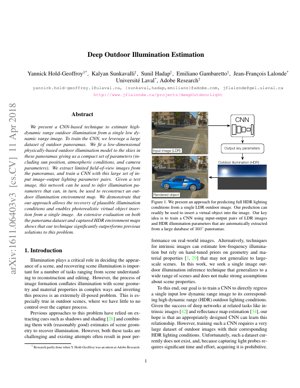
The most compelling demonstration is the photorealistic insertion of virtual objects into test images. Figure 1 in the PDF conceptually shows this pipeline: an input LDR image is fed to the CNN, which outputs sky parameters used to reconstruct an HDR environment map. A virtual object is then rendered under this estimated illumination and composited into the original image. Successful results show consistent lighting direction, color, and intensity between the virtual object and the real scene, validating the accuracy of the estimated illumination.
5. Analysis Framework: Core Insight & Logical Flow
Core Insight: The paper's genius is its elegant data-centric workaround. Instead of tackling the impossible task of collecting massive real-world LDR-HDR pairs, the authors cleverly repurpose existing LDR panoramas by using a parametric physical model as a "bridge" to generate plausible HDR supervision. This is reminiscent of the paradigm shift enabled by works like CycleGAN, which learned mappings between domains without paired examples. Here, the Hošek-Wilkie model acts as a physics-informed teacher, distilling complex illumination into a learnable representation.
Logical Flow: The logic is sound but hinges on a critical assumption: that the Hošek-Wilkie model is sufficiently accurate and general to represent the diverse illumination conditions in the training panoramas. Any systematic bias in the model or fitting process is directly baked into the CNN's "ground truth," limiting its upper bound of performance. The flow is: Panorama (LDR) -> Model Fitting -> Parameters (Compact Truth) -> CNN Training -> Single Image -> Parameter Prediction -> HDR Synthesis. It's a classic example of "learning the inverse of a forward model."
Strengths & Flaws: The major strength is practicality and scalability. The method is trainable and produces state-of-the-art results for its time. However, its flaws are inherent to its design. First, it's fundamentally limited to clear-sky, daylight conditions modeled by Hošek-Wilkie. Overcast skies, dramatic weather, or urban canyon effects with complex indirect light are poorly handled. Second, it requires visible sky in the input image—a significant limitation for many user-generated photos. The method, as described, is a sky model regressor, not a full scene illuminant estimator.
Actionable Insights: For practitioners, this work is a masterclass in leveraging indirect supervision. The takeaway is to always look for existing data assets (like panorama databases) and domain knowledge (like physical models) that can be combined to create training signals. The future evolution of this idea, as seen in later works from Google Research and MIT, is to move beyond parametric sky models towards end-to-end, non-parametric HDR environment map prediction using more powerful architectures (like GANs or NeRFs) and even larger, more diverse datasets, potentially incorporating temporal information from videos.
6. Application Outlook & Future Directions
The immediate application is in augmented reality for believable outdoor object insertion in photography and film (e.g., for visual effects). Future directions include:
- Expanding Illumination Models: Integrating models for overcast skies, twilight, and artificial nighttime lighting to handle a broader range of conditions.
- Sky-Free Estimation: Developing techniques that can infer illumination from ground planes, shadows, and object shading when the sky is occluded, perhaps by incorporating explicit geometry estimation.
- Dynamic Illumination: Extending the approach to video for estimating time-varying illumination, crucial for consistent AR in dynamic scenes.
- Integration with Neural Rendering: Coupling illumination estimation with neural radiance fields (NeRF) for joint scene reconstruction and relighting, a direction actively pursued by labs like UC Berkeley and NVIDIA.
- On-Device Optimization: Lightweight network architectures for real-time estimation on mobile devices, enabling consumer AR applications.
7. References
- Hold-Geoffroy, Y., Sunkavalli, K., Hadap, S., Gambaretto, E., & Lalonde, J. F. (2018). Deep Outdoor Illumination Estimation. arXiv preprint arXiv:1611.06403.
- Hošek, L., & Wilkie, A. (2012). An analytic model for full spectral sky-dome radiance. ACM Transactions on Graphics (TOG), 31(4), 1-9.
- Barron, J. T., & Malik, J. (2015). Shape, illumination, and reflectance from shading. IEEE transactions on pattern analysis and machine intelligence, 37(8), 1670-1687.
- Zhu, J. Y., Park, T., Isola, P., & Efros, A. A. (2017). Unpaired image-to-image translation using cycle-consistent adversarial networks. In Proceedings of the IEEE international conference on computer vision (pp. 2223-2232).
- Mildenhall, B., Srinivasan, P. P., Tancik, M., Barron, J. T., Ramamoorthi, R., & Ng, R. (2020). NeRF: Representing Scenes as Neural Radiance Fields for View Synthesis. In European conference on computer vision (pp. 405-421). Springer, Cham.
- Google AI Blog: "Looking to Lift: A New Model for Estimating Outdoor Illumination" (Representative of follow-up industry research).