1. Introduction
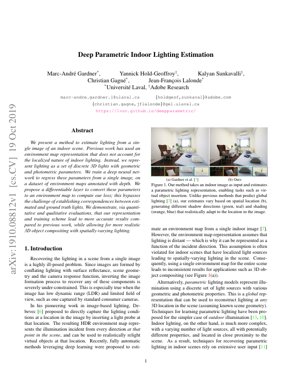
Recovering scene lighting from a single image is a classic, ill-posed inverse problem in computer vision. Traditional methods, particularly for indoor scenes, often rely on environment maps—a distant lighting assumption frequently violated by localized light sources like lamps, leading to unrealistic results for applications like virtual object insertion (see Figure 1). This paper introduces a novel deep learning approach that bypasses this limitation by estimating a parametric 3D lighting model directly from a single low-dynamic-range (LDR) indoor image.
The core contribution is a shift from a global, direction-based representation to a set of discrete 3D light sources with geometric (position, area) and photometric (intensity, color) parameters. This allows for spatially-varying illumination, meaning shadows and shading correctly adapt to an object's location in the scene, as demonstrated in the teaser figure.
2. Methodology
2.1 Parametric Lighting Representation
The method represents indoor lighting as a collection of $N$ area lights. Each light $L_i$ is parameterized by:
- Position: $\mathbf{p}_i \in \mathbb{R}^3$ (3D location in scene coordinates).
- Area: $a_i \in \mathbb{R}^+$ (defining the spatial extent of the light).
- Intensity: $I_i \in \mathbb{R}^+$.
- Color: $\mathbf{c}_i \in \mathbb{R}^3$ (RGB values).
This set of parameters $\Theta = \{ \mathbf{p}_i, a_i, I_i, \mathbf{c}_i \}_{i=1}^{N}$ provides a compact, physically interpretable description of the scene's illumination that can be evaluated at any 3D point.
2.2 Network Architecture
A deep neural network is trained to regress the parameters $\Theta$ from a single RGB input image. The network follows an encoder-decoder structure:
- Encoder: A convolutional backbone (e.g., ResNet) extracts a latent feature vector from the input image.
- Decoder: Fully-connected layers map the latent vector to the $N \times 8$ output parameters (3 for position, 1 for area, 1 for intensity, 3 for color).
The model is trained on a dataset of indoor High Dynamic Range (HDR) environment maps, manually annotated with corresponding depth maps and fitted parametric lights.
2.3 Differentiable Rendering Layer
A key innovation is a differentiable layer that converts the predicted parameters $\Theta$ back into a standard environment map $E(\Theta)$ at a specific query location. This allows the loss to be computed in the image domain (comparing rendered vs. ground truth environment maps) without needing explicit correspondence between individual predicted and ground-truth lights. The loss function can be formulated as:
$\mathcal{L} = \| E(\Theta) - E_{gt} \| + \lambda \mathcal{R}(\Theta)$
where $E_{gt}$ is the ground truth environment map, and $\mathcal{R}$ is an optional regularization term on the parameters.
3. Experiments & Results
3.1 Quantitative Evaluation
The paper evaluates performance using standard metrics for lighting estimation, such as Mean Angular Error (MAE) on the predicted environment maps and perceptual metrics. The proposed parametric method shows superior quantitative performance compared to previous non-parametric (environment map prediction) baselines like Gardner et al. [7], particularly when evaluating lighting accuracy at multiple spatial locations within a scene.
Performance Comparison
Baseline (Global Env. Map): Higher angular error, fails to capture spatial variation.
Ours (Parametric): Lower error across metrics, enables per-location evaluation.
3.2 Qualitative Evaluation
Qualitative results demonstrate a clear advantage. The predicted lights correspond plausibly to real light sources in the input image (windows, lamps). When visualized, the reconstructed environment maps show more accurate high-frequency details (sharp shadows) and color reproduction compared to blurrier, averaged results from global methods.
3.3 Virtual Object Compositing
The most compelling application is photorealistic virtual object insertion. Using the estimated 3D light parameters, a virtual object can be rendered with correct, spatially-varying shading and shadows. As an object moves through the scene (e.g., from a desk to under a lamp), its illumination changes realistically—a feat impossible with a single global environment map. Figure 1(b) in the PDF illustrates this with distinct shadow directions and shading intensities for different object placements.
4. Technical Analysis & Framework
4.1 Core Insight & Logical Flow
Let's cut through the academic veneer. The core insight here isn't just another incremental improvement in network architecture; it's a fundamental repackaging of the problem statement. The authors recognized that the standard "environment map" output of prior work (like the influential work of Gardner et al.) was essentially a dead-end for realistic AR/VR applications. It's a brilliant hack that treats the symptom (predicting lighting) but ignores the disease (lighting is local). Their logical flow is razor-sharp: 1) Acknowledge the physical constraint (localized indoor lights), 2) Choose a representation that inherently models it (parametric 3D lights), 3) Build a bridge (the differentiable renderer) to still use abundant image-based data for training. This is reminiscent of the shift in generative models from direct pixel prediction (like early GANs) to learning latent representations of 3D structure, as seen in frameworks like NeRF.
4.2 Strengths & Flaws
Strengths:
- Physical Plausibility & Editability: The parameter set is an artist's dream. You can directly tweak light position or intensity—a level of control absent from black-box environment map pixels. This bridges the gap between AI estimation and practical graphics pipelines.
- Spatial Awareness: This is the killer feature. It solves the "one-light-fits-all" fallacy of previous methods, making true augmented reality compositing feasible.
- Data-Efficient Representation: A few dozen parameters are far more compact than a full HDR environment map, potentially leading to more robust learning from limited data.
Flaws & Open Questions:
- The "N" Problem: The network predicts a fixed, pre-defined number of lights. What about scenes with more or fewer sources? This is a brittle assumption. Dynamic graph networks or object-detection-inspired approaches might be necessary next steps.
- Geometry Dependency: The method's training and evaluation rely on depth-annotated data. Its performance in the wild, without known geometry, is a major unanswered question. It likely couples the lighting and geometry estimation problems tightly.
- Occlusion & Complex Interactions: The current model uses simple area lights. Real indoor lighting involves complex inter-reflections, occlusions, and non-diffuse surfaces (e.g., glossy tables). The paper's compositing results, while good, still have a slightly "clean" CG look that hints at these missing complexities.
4.3 Actionable Insights
For practitioners and researchers:
- Benchmarking is Key: Don't just report angular error on a cropped environment map. The field must adopt task-based metrics like realism scores in object compositing tasks, judged by human studies or advanced perceptual models (e.g., based on LPIPS or similar). This paper's qualitative compositing figures are more convincing than any single-number metric.
- Embrace Differentiable Physics: The differentiable renderer is the linchpin. This trend, popularized by projects like PyTorch3D and Mitsuba 2, is the future for bridging learning and graphics. Invest in building these layers for your domain.
- Look Beyond Supervision: The need for paired HDR environment maps with depth is a bottleneck. The next breakthrough will come from methods that learn lighting priors from unlabeled internet photos or video, perhaps using self-supervised constraints from multi-view geometry or object consistency, akin to principles in landmark works like "Learning to See in the Dark" or from datasets like MegaDepth.
Analysis Framework Example (Non-Code): To critically evaluate any new lighting estimation paper, apply this three-point framework: 1) Representation Fidelity: Does the output format physically support spatial variation and editing? (Parametric > Env. Map). 2) Training Pragmatism: Does the method require impossibly perfect supervision (full 3D scene scan) or can it learn from weaker signals? 3) Task Performance: Does it demonstrably improve a real application (compositing, relighting) beyond a synthetic metric? This paper scores highly on 1 and 3, but 2 remains a challenge.
5. Future Applications & Directions
The implications of robust parametric lighting estimation are vast:
- Augmented & Virtual Reality: Enabling truly persistent and realistic AR content that interacts believably with room lighting. Virtual objects could cast correct shadows on real surfaces and appear illuminated by the user's desk lamp.
- Computational Photography & Post-Processing: Allowing for professional-level photo editing like post-capture relighting, object insertion, and consistent shadow adjustment in images and videos.
- Architectural Visualization & Interior Design: Users could take a photo of a room and virtually "try out" different lighting fixtures or furniture under the existing illumination conditions.
- Robotics & Embodied AI: Providing robots with a richer understanding of the 3D environment, aiding in navigation, manipulation, and scene understanding.
Future Research Directions:
- Joint Estimation with Geometry: Developing end-to-end models that co-estimate scene depth, layout, and lighting from a single image, reducing dependency on pre-computed geometry.
- Dynamic & Video-based Estimation: Extending the approach to video for estimating temporal changes in lighting (e.g., someone turning a light on/off).
- Integration with Neural Rendering: Combining parametric lights with neural radiance fields (NeRFs) to achieve ultra-realistic novel view synthesis and editing.
- Unsupervised & Weakly-Supervised Learning: Exploring learning from in-the-wild image collections without HDR/depth ground truth.
6. References
- Gardner, M.-A., Hold-Geoffroy, Y., Sunkavalli, K., Gagné, C., & Lalonde, J.-F. (2019). Deep Parametric Indoor Lighting Estimation. arXiv preprint arXiv:1910.08812.
- Gardner, M.-A., et al. (2017). Learning to Predict Indoor Illumination from a Single Image. ACM TOG.
- Debevec, P. (1998). Rendering Synthetic Objects into Real Scenes: Bridging Traditional and Image-Based Graphics with Global Illumination and High Dynamic Range Photography. ACM SIGGRAPH.
- Hold-Geoffroy, Y., Sunkavalli, K., et al. (2017). Deep Outdoor Illumination Estimation. IEEE CVPR.
- Mildenhall, B., et al. (2020). NeRF: Representing Scenes as Neural Radiance Fields for View Synthesis. ECCV.
- Zhang, R., et al. (2018). The Unreasonable Effectiveness of Deep Features as a Perceptual Metric. IEEE CVPR. (LPIPS)
- Li, Z., & Snavely, N. (2018). MegaDepth: Learning Single-View Depth Prediction from Internet Photos. IEEE CVPR.