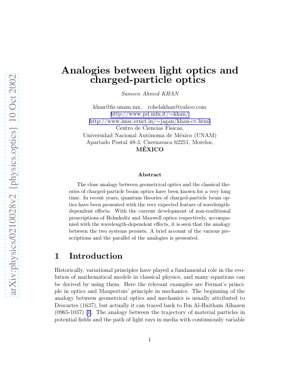
Analogies Between Light Optics and Charged-Particle Optics: A Quantum Perspective
Explores the historical and modern analogies between light optics and charged-particle beam optics, focusing on quantum formalisms and wavelength-dependent effects.
Home »
Documentation »
Analogies Between Light Optics and Charged-Particle Optics: A Quantum Perspective
1. Introduction
The paper establishes a profound and persistent analogy between the theories of light optics and charged-particle beam optics. This connection, historically rooted in the variational principles of Fermat (optics) and Maupertuis (mechanics), was formalized by William Rowan Hamilton in 1833. Hamilton's analogy directly enabled the development of practical electron optics in the 1920s, leading to inventions like the electron microscope. Traditionally, this analogy was confined to the realm of geometrical optics and classical mechanics. However, the advent of quantum mechanics and the associated de Broglie wavelength for particles introduced a new layer of complexity—and opportunity.
The core thesis of this work is that the analogy not only survives but is enriched when moving to quantum descriptions. Recent developments in quantum theories of charged-particle beam optics and corresponding non-traditional wave optics prescriptions (Helmholtz and Maxwell optics) reveal a deeper, wavelength-dependent correspondence. This paper provides a brief account of these parallel developments, arguing for a unified framework under the emerging field of Quantum Aspects of Beam Physics (QABP).
2. Quantum Formalism
This section outlines the shift from classical to quantum descriptions in beam optics.
2.1. Historical Context and Classical Foundations
The classical treatment, based on Hamiltonian mechanics and geometrical ray tracing, has been remarkably successful in designing devices from electron microscopes to particle accelerators. It treats particle trajectories akin to light rays in a medium with a variable refractive index. The foundational work of Busch on magnetic lens action is a direct application of this optical-mechanical analogy.
2.2. Quantum Prescriptions: Schrödinger, Klein-Gordon, and Dirac
The paper posits that a fundamental quantum prescription is necessary, as all physical systems are quantum at their core. The approach starts from the basic equations of quantum mechanics:
Schrödinger equation: For non-relativistic spin-0 particles.
Klein-Gordon equation: For relativistic spin-0 particles.
Dirac equation: For relativistic spin-1/2 particles (like electrons).
The goal is to derive beam-optical Hamiltonians from these equations to describe the evolution of wavefunctions (representing beam profiles) through optical elements like quadrupoles and bending magnets. This formalism inherently includes wavelength-dependent effects (diffraction, interference), which have no analogue in classical geometrical optics.
2.3. Non-Traditional Prescriptions: Helmholtz and Maxwell Optics
To complete the analogy on the light optics side, the author references developments beyond geometrical optics:
Helmholtz Optics: A wave optics treatment starting from the Helmholtz equation $\nabla^2 E + k^2 n^2(\mathbf{r}) E = 0$, which is the scalar wave equation for monochromatic light. This is shown to be in close analogy with the quantum theory based on the Klein-Gordon equation.
Matrix Formulation of Maxwell Optics: A full vector wave treatment based on Maxwell's equations. This is presented as being in close analogy with the quantum theory based on the Dirac equation, particularly due to its handling of polarization/spin-like degrees of freedom.
These "non-traditional" prescriptions for light introduce their own wavelength-dependent effects, thus restoring and deepening the parity with quantum charged-particle optics.
3. Core Insight & Logical Flow
Core Insight: The paper's central, powerful claim is that the century-old analogy between optics and mechanics isn't a historical curiosity—it's a structural blueprint that scales from classical to quantum regimes. Khan argues we're not looking at two separate fields with occasional overlaps, but at a single, unified meta-theory of wave propagation manifesting in different physical substrates (photons vs. electrons). The most significant modern implication is that wavelength-dependent quantum corrections in particle beams have direct, testable analogues in advanced wave optics. This isn't just an academic exercise; it suggests that breakthroughs in correcting chromatic aberration in electron microscopes could be inspired by techniques in photonic crystal design, and vice-versa.
Logical Flow: The argument builds impeccably: (1) Establish the historical, classical analogy (Hamilton) as proven and productive (e.g., electron microscope). (2) Identify the "break" in the analogy caused by the advent of quantum mechanics—particles gained a wavelength, but traditional optics remained geometrical. (3) Bridge this gap by introducing two parallel modern developments: quantum charged-particle optics (which adds wave effects to particles) and non-traditional wave optics (Helmholtz/Maxwell, which provides a more complete wave theory for light). (4) Demonstrate that these two modern frameworks are themselves analogous (Klein-Gordon/Helmholtz, Dirac/Maxwell), thus completing and elevating the analogy to a higher, more fundamental level. The flow is from classical convergence, through a quantum divergence, to a modern re-convergence at a more sophisticated tier.
4. Strengths & Flaws: A Critical Analysis
Strengths:
Conceptual Unification: The paper's greatest strength is its bold synthesis. It successfully ties together disparate advanced topics (Dirac equation, Maxwell optics, beam physics) into a coherent narrative. This kind of interdisciplinary mapping is crucial for fostering innovation, as seen in fields like topological photonics which borrowed from condensed matter physics.
Future-Oriented: It correctly identifies and champions the then-nascent field of Quantum Aspects of Beam Physics (QABP), positioning the analogy not as a look back, but as a guide for future research. This foresight has been validated, as QABP and related studies in coherent electron beams have grown significantly.
Pedagogical Framework: The "table of Hamiltonians" mentioned (though not shown in the excerpt) is a powerful tool. It provides a direct, mathematical dictionary for translating problems and solutions between the domains.
Flaws & Limitations:
The "Analogy" vs. "Identity" Trap: The paper sometimes risks overstating the analogy as a direct equivalence. While the mathematical structures may map, the physical scales, dominant effects, and practical constraints differ enormously. The de Broglie wavelength of a 100 keV electron is picometers, while optical wavelengths are hundreds of nanometers. This means "wave effects" manifest in radically different ways and relative strengths. A solution perfect for one domain may be physically impossible or irrelevant in the other.
Lack of Concrete Validation: As a brief note/overview, it presents the conceptual framework but offers little in the way of concrete experimental results or novel predictions stemming from this unified view. It tells us the bridge exists but doesn't show us a significant cargo crossing it. Contrast this with a paper like that on CycleGAN (Zhu et al., 2017), which presented a novel framework and immediately demonstrated its power with compelling, tangible image translation results.
Underdeveloped Engineering Link: The jump from abstract Hamiltonian analogies to practical device design is immense. The paper doesn't sufficiently address the engineering challenges—like the immense magnetic fields needed to focus high-energy particles versus the dielectric structures used for light—that limit direct technology transfer.
5. Actionable Insights & Strategic Implications
For researchers and R&D strategists, this paper is a mandate to break down silos.
Establish Cross-Disciplinary Collaborations: Labs working on aberration correction in electron microscopy should have active channels with groups in computational wave optics and photonic device design. Conferences should be explicitly designed to mix these communities.
Leverage Computational Tools: The matrix formalism for Maxwell optics and the quantum propagation algorithms are computationally analogous. Investment should be made in developing or adapting software libraries (e.g., building on platforms like MEEP for photonics or GPT for particle beams) that can handle problems in both domains with minimal modification.
Focus on the "Sweet Spot": Instead of forcing the analogy everywhere, identify problems where the mapping is most fruitful. Coherence manipulation is a prime candidate. Techniques for generating vortex beams or orbital angular momentum states in light (using spatial light modulators) could inspire methods for creating structured electron beams, with applications in advanced materials probing.
Re-examine "Classical" Devices with Quantum Eyes: Use the quantum formalism to audit existing particle accelerators and microscopes. Where are the neglected wavelength-dependent effects limiting performance? This could lead to incremental but valuable design optimizations, even before building fully quantum-based devices.
In essence, Khan's paper is less a finished solution and more a powerful research heuristic. Its value lies in consistently asking: "We solved this wave problem in optics/particles; what is the analogous problem in the other domain, and does our solution map over?" This simple question, rigorously pursued, can unlock novel approaches in both fields.
6. Technical Details and Mathematical Framework
The heart of the analogy lies in the formal similarity of the governing equations and the derived "beam-optical" Hamiltonians. The classical analogy starts from the Hamiltonian for a charged particle in electromagnetic fields:
$$H_{cl} = \frac{1}{2m}(\mathbf{p} - q\mathbf{A})^2 + q\phi$$
which, under the paraxial (small-angle) approximation and a suitable choice of coordinate along the optic axis (z), can be cast into a form analogous to the Hamiltonian of geometrical optics.
The quantum leap begins with equations like the Dirac equation for a spin-1/2 particle:
$$\left[ c\boldsymbol{\alpha}\cdot(\mathbf{p} - q\mathbf{A}) + \beta mc^2 + q\phi \right]\Psi = i\hbar\frac{\partial\Psi}{\partial t}$$
Through a systematic procedure (like a Foldy-Wouthuysen transformation or direct factorization), one derives an effective Hamiltonian for the propagation of the wavefunction's components along z. This Hamiltonian, $\hat{\mathcal{H}}_\text{opt}$, will contain terms proportional to powers of the de Broglie wavelength $\lambda_\text{dB} = h/p$, representing quantum/wave corrections. For example, a typical structure might be:
$$\hat{\mathcal{H}}_\text{opt} = \hat{\mathcal{H}}_0 + \lambda_\text{dB}\,\hat{\mathcal{H}}_1 + \lambda_\text{dB}^2\,\hat{\mathcal{H}}_2 + \cdots$$
where $\hat{\mathcal{H}}_0$ reproduces the classical geometrical optics result, and $\hat{\mathcal{H}}_1$, $\hat{\mathcal{H}}_2$ introduce quantum aberrations (e.g., diffraction).
On the light optics side, starting from the vector Helmholtz equation derived from Maxwell's equations:
$$\nabla^2 \mathbf{E} + \frac{\omega^2}{c^2}n^2(\mathbf{r})\mathbf{E} = 0$$
A similar paraxial procedure leads to a matrix differential equation for the propagation of the electric field vector, where the wave number $k=2\pi/\lambda_\text{light}$ plays the role analogous to $1/\lambda_\text{dB}$.
7. Analysis Framework: Case Study on Aberration Correction
Scenario: Correcting spherical aberration ($C_s$) in a high-resolution electron microscope. Classically, $C_s$ is a geometric defect of magnetic lenses. Quantum-mechanically, it has contributions intertwined with diffraction.
Analogous Optics Problem: Correcting spherical aberration and diffraction in a high-numerical-aperture (NA) optical microscope or laser focusing system.
Framework Application:
Map the Hamiltonians: Identify the terms in the quantum particle-optical Hamiltonian $\hat{\mathcal{H}}_\text{opt}$ that correspond to $C_s$. Find the mathematically isomorphic terms in the matrix Hamiltonian derived from Maxwell optics for a high-NA system.
Translate the Solution: In advanced optics, $C_s$ and diffraction are often corrected simultaneously using adaptive optics (deformable mirrors) or diffractive optical elements (DOEs) and phase plates. The phase profile $\Phi(\mathbf{r})$ applied by a perfect corrective optic in the light domain is calculated via inverse wave propagation.
Adapt and Test: The core insight is that the required phase correction $\Phi(\mathbf{r})$ maps to a required modification of the electron wavefront. This cannot be done with a deformable mirror but could be inspired by the concept of DOEs. This has led to the development of electron phase plates and, more recently, concepts for programmable electron phase modulators using nanofabricated structures or controlled electromagnetic fields, directly analogous to spatial light modulators (SLMs) in optics.
This framework doesn't give a ready-made answer but provides a systematic pathway: the well-developed synthesis algorithms for computer-generated holograms in optics become starting points for designing electron wavefront shaping devices.
8. Future Applications and Research Directions
The unified perspective opens several promising avenues:
Quantum-Limited Beam Diagnostics: Using concepts from quantum optics (e.g., homodyne detection, squeezing) to measure particle beam emittance and coherence properties at the Heisenberg limit, surpassing classical diagnostic techniques.
Structured Particle Beams: Creating electron or ion beams with orbital angular momentum, Airy profiles, or Bessel modes—directly inspired by structured light—for novel interactions with matter in spectroscopy and microscopy.
Coherent Control in Accelerators: Applying principles of coherent control from laser physics to tailor particle bunch profiles on femtosecond timescales, potentially improving the efficiency of free-electron lasers and advanced acceleration schemes.
Topological Beam Optics: Exploring whether topological phases and protected edge states, a major theme in modern photonics (e.g., topological insulators for light), have analogues in charged-particle beam transport in periodic magnetic lattices, potentially leading to robust beam guides.
Unified Simulation Suites: Developing next-generation simulation software that uses a common core solver for wave propagation, configurable for photons, electrons, or other quantum particles, dramatically accelerating cross-disciplinary design.
The ultimate direction is towards a fully integrated Quantum Engineering of Beams, where the particle/wave duality is not a hindrance but a design parameter, manipulated with the same level of control achieved in modern photonics.
9. References
Khan, S. A. (2002). Analogies between light optics and charged-particle optics. arXiv:physics/0210028v2.
Hawkes, P. W., & Kasper, E. (2018). Principles of Electron Optics (Vol. 1-4). Academic Press. (The definitive treatise on classical electron optics).
Dragt, A. J. (1982). Lie Algebraic Theory of Geometrical Optics and Optical Aberrations. Journal of the Optical Society of America, 72(3), 372-379. (Key paper on the Hamiltonian formalism).
Zhu, J. Y., Park, T., Isola, P., & Efros, A. A. (2017). Unpaired Image-to-Image Translation using Cycle-Consistent Adversarial Networks. Proceedings of the IEEE International Conference on Computer Vision (ICCV). (Example of a paper presenting a novel framework with immediate, demonstrable results).
Rodrigues, G. M., & de Assis, A. J. (2021). Quantum aspects of charged particle beam optics: a review. The European Physical Journal D, 75(7). (A modern review showing the field's growth).
Verbeeck, J., Tian, H., & Schattschneider, P. (2010). Production and application of electron vortex beams. Nature, 467(7313), 301-304. (Landmark experimental paper realizing structured electron beams).
OAM Workshop Series. Quantum Aspects of Beam Physics (QABP). Proceedings available from Stanford Linear Accelerator Center (SLAC) and other host institutions. (The conference series cited in the paper, documenting ongoing research).