Table of Contents
1. Introduction
Portrait harmonization is a critical task in computational photography and image editing, aiming to seamlessly composite a foreground subject into a new background. Traditional methods often fail to account for complex lighting interactions, leading to unrealistic results. This paper introduces Relightful Harmonization, a novel diffusion-based framework that explicitly models and transfers lighting conditions from the background to the foreground portrait, achieving superior photorealism.
2. Methodology
The proposed framework operates in three core stages, moving beyond simple color matching to achieve true lighting coherence.
2.1 Lighting Representation Module
This module extracts implicit lighting cues (e.g., direction, intensity, color temperature) from a single target background image. It encodes these cues into a latent lighting representation $L_{bg}$ that serves as a conditioning signal for the diffusion model. This bypasses the need for explicit HDR environment maps during inference.
2.2 Alignment Network
To ground the learned lighting features in a physically meaningful space, an alignment network is introduced. It aligns the image-derived lighting features $L_{bg}$ with features extracted from full panorama environment maps $L_{env}$ during training. This connection ensures the model learns a robust and generalizable understanding of scene illumination, as validated by datasets like Laval Indoor HDR.
2.3 Synthetic Data Pipeline
A key innovation is a data simulation pipeline that generates diverse, high-quality training pairs. It composites human subjects from existing datasets (e.g., FFHQ) onto varied backgrounds with known lighting, creating paired data {foreground, background, harmonized ground truth} without requiring costly light-stage captures. This addresses a major data bottleneck in the field.
3. Technical Details
The model builds upon a pre-trained latent diffusion model (LDM). The core generative process is guided by the lighting condition. The denoising process at timestep $t$ can be formulated as:
$\epsilon_\theta(z_t, t, \tau(L_{bg}), \tau(mask))$
where $z_t$ is the noisy latent, $\epsilon_\theta$ is the UNet denoiser, $\tau(\cdot)$ denotes conditioning encoders, $L_{bg}$ is the background lighting representation, and $mask$ is the foreground alpha mask. The alignment network optimizes a feature consistency loss $\mathcal{L}_{align} = ||\phi(L_{bg}) - \psi(L_{env})||_2$, where $\phi$ and $\psi$ are projection networks.
4. Experiments & Results
The method was evaluated against state-of-the-art harmonization (e.g., DoveNet, S2AM) and relighting baselines. Quantitative metrics (PSNR, SSIM, LPIPS, FID) and user studies consistently ranked Relightful Harmonization highest for visual realism and lighting consistency.
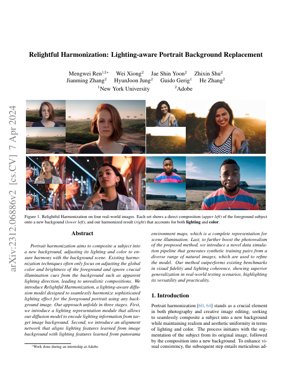
Figure 1 Analysis: The paper's Figure 1 compellingly demonstrates the model's capability. It shows four real-world examples where a direct composite (subject pasted onto background) looks jarring due to mismatched lighting direction and shadow placement. In contrast, the model's output convincingly relights the subject: skin tones adapt to the ambient color, highlights and shadows are repositioned to match the new light source, and the overall integration appears photorealistic.
5. Analysis Framework: Core Insight & Critique
Core Insight: The paper's fundamental breakthrough is recognizing that true harmonization is a relighting problem in disguise. While prior work like CycleGAN (Zhu et al., 2017) excelled at unpaired style transfer, it treated lighting as a mere color style. This work correctly identifies lighting direction, shadow casting, and specular highlights as geometric and physical phenomena that must be explicitly modeled, not just statistically matched. It smartly leverages the structural priors of diffusion models to solve this ill-posed inverse problem.
Logical Flow: The three-stage pipeline is elegantly logical. 1) Perceive lighting from an image (a hard problem). 2) Ground that perception in a known, complete representation (panorama maps) during training to ensure physical plausibility. 3) Synthesize vast training data to teach the model this complex mapping. It's a classic "define, align, scale" research strategy executed well.
Strengths & Flaws: The primary strength is its practicality—it works with a single background image, a massive advantage over methods requiring HDR panoramas. The synthetic data pipeline is a masterstroke for scalability. However, the flaw lies in its opacity: as a dense diffusion model, it's a black box. We don't get an interpretable lighting model (e.g., a 3D SH coefficient vector) as output, limiting its use in downstream graphics pipelines. It also likely struggles with extreme lighting contrasts or highly specular materials, common failure modes for generative models.
Actionable Insights: For product teams, this is a ready-to-integrate API for premium photo editing tools. For researchers, the future is clear: 1) Disentangle the latent lighting code into interpretable parameters (direction, intensity, softness). 2) Extend to video for temporal consistency—a monumental but necessary challenge. 3) Collaborate with the NeRF/3D reconstruction community. The logical endpoint is not just harmonizing a 2D layer, but inserting a relit 3D asset into a scene, a vision shared by projects from MIT CSAIL and Google Research.
6. Future Applications & Directions
- Augmented & Virtual Reality: Real-time harmonization of live camera feed with virtual environments for immersive experiences.
- Film & Video Post-Production: Automated and consistent lighting adjustment for characters composited into CGI backgrounds, drastically reducing VFX costs.
- Virtual Try-On & Fashion: Applying realistic lighting and shadows to products or clothing composited onto user photos.
- Telepresence & Videoconferencing: Normalizing lighting conditions for all participants to create a cohesive virtual meeting space.
- Research Direction: Integration with 3D-aware generative models (e.g., 3D Gaussian Splatting) to achieve viewpoint-consistent relighting and shadow casting.
7. References
- Ren, M., Xiong, W., Yoon, J. S., et al. (2024). Relightful Harmonization: Lighting-aware Portrait Background Replacement. arXiv:2312.06886v2.
- Zhu, J., Park, T., Isola, P., & Efros, A. A. (2017). Unpaired Image-to-Image Translation using Cycle-Consistent Adversarial Networks. IEEE ICCV.
- Rombach, R., Blattmann, A., Lorenz, D., Esser, P., & Ommer, B. (2022). High-Resolution Image Synthesis with Latent Diffusion Models. IEEE CVPR.
- Zhang, L., et al. (2021). S2AM: A Lightweight Network for Image Harmonization. ACM MM.
- Debevec, P. (2012). The Light Stage and its Applications to Photoreal Digital Actors. SIGGRAPH Courses.
- Mildenhall, B., et al. (2020). NeRF: Representing Scenes as Neural Radiance Fields for View Synthesis. ECCV.