Table of Contents
1. Introduction & Overview
Visible Light Communication (VLC) is emerging as a complementary wireless technology to RF, leveraging ubiquitous LED lighting for data transmission. The paper presents OpenVLC1.3, the latest iteration of an open-source, low-cost, and software-defined platform for VLC research. Building upon its predecessors, OpenVLC1.3 addresses critical limitations in data rate, range, and robustness, achieving a 400 kb/s UDP throughput and a 3.5x increase in communication distance without added hardware cost. This platform is positioned to accelerate prototyping and experimentation in VLC, aligning with growing industry standardization efforts like IEEE 802.11bb.
400 kb/s
Peak UDP Throughput (4x improvement)
3.5x
Increase in Communication Range
2 MHz
Sampling Rate Capability
Low-Cost
Off-the-shelf Hardware
2. System Architecture & Design
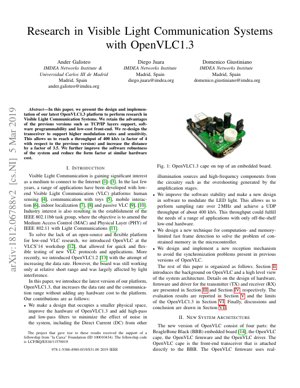
The OpenVLC1.3 system is architected around four core components: the BeagleBone Black (BBB) embedded board, the custom OpenVLC Cape (front-end transceiver), the OpenVLC Firmware running on the BBB's Programmable Real-Time Unit (PRU), and the OpenVLC Driver in the Linux kernel. This design cleanly separates time-sensitive PHY operations (handled by the PRU) from higher-layer networking stack functions.
2.1 Hardware Design (OpenVLC Cape)
The redesigned cape features a smaller form factor and incorporates critical analog front-end improvements:
- Enhanced LED Driver: Supports a more powerful LED for higher optical output.
- Noise Mitigation Filters: Integrated high-pass and low-pass filters to suppress DC offset from ambient light and high-frequency circuit noise (e.g., amplifier overshoot).
- Improved Photodetector (PD) Circuit: Higher sensitivity receiver path.
2.2 Software & Firmware Stack
The software architecture (Fig. 2 in the PDF) is layered:
- Kernel Driver: Manages communication between the user-space network stack and the PRU firmware.
- PRU Firmware: Executes real-time modulation/demodulation, symbol timing, and the novel fast frame detection algorithm designed for memory-constrained microcontrollers.
- Network Stack: Provides standard TCP/IP support, enabling seamless integration with internet protocols.
3. Technical Contributions & Innovations
3.1 Transmitter (TX) Enhancements
A new software design for LED modulation enables a sampling rate exceeding 2 MHz. The direct connection from the kernel driver to the PRU firmware reduces latency and jitter, which is crucial for achieving stable high-speed modulation.
3.2 Receiver (RX) & Signal Processing
Two key algorithms were developed:
- Fast Frame Detection: A lightweight algorithm for preamble detection that minimizes computational and memory footprint on the PRU.
- New Symbol Detection & Synchronization: Addresses synchronization issues from prior versions, improving reliability under varying channel conditions.
3.3 Key Performance Metrics
The paper provides a comparative table (Table I) summarizing the evolution:
- OpenVLC1.0: 18 kb/s, kernel-based software.
- OpenVLC1.2: 100 kb/s, moved processing to firmware.
- OpenVLC1.3: 400 kb/s, enhanced hardware filters, advanced firmware algorithms.
4. Evaluation & Results
The evaluation likely demonstrates the platform's performance under various conditions. While specific BER (Bit Error Rate) vs. SNR (Signal-to-Noise Ratio) curves or distance-throughput plots are not detailed in the provided excerpt, the paper claims successful validation of the 400 kb/s throughput and improved range. The effectiveness of the new filters in mitigating ambient light interference (a major challenge for VLC) would be a critical result. The stability of the new driver and firmware under extended operation is also a key metric of success.
Chart Description (Inferred): A line chart would likely show UDP throughput (y-axis) versus transmission distance (x-axis) for OpenVLC1.2 and OpenVLC1.3, clearly illustrating the 3.5x range extension for a target throughput (e.g., 100 kb/s). Another chart might show Packet Error Rate (PER) under different levels of ambient light noise, highlighting the improvement due to the new analog filters.
5. Core Insight & Analyst Perspective
Core Insight: OpenVLC1.3 isn't just an incremental upgrade; it's a strategic enabler that democratizes high-fidelity VLC research. By cracking the 400 kb/s barrier with a sub-$100 platform, it shifts VLC prototyping from a niche, high-cost endeavor into the realm of accessible experimentation, directly fueling the innovation pipeline for IEEE 802.11bb and beyond.
Logical Flow: The authors correctly identify the bottleneck in low-end VLC: not just raw speed, but robustness at speed. Their logic flows from noise suppression (hardware filters) to stable high-rate modulation (firmware redesign) to efficient packet handling (novel detection algorithms). This full-stack approach is what yields the 4x/3.5x gains—a lesson many modular research platforms miss.
Strengths & Flaws: The strength is undeniable: cost-performance ratio and open-source ethos. It fills a critical gap, similar to how USRP devices revolutionized software-defined radio research. However, the flaw is in the horizon. 400 kb/s, while impressive for the platform, is still orders of magnitude below state-of-the-art VLC research using specialized hardware (which can reach multiple Gb/s). The platform risks creating a "low-end bubble" if the community doesn't use it as a stepping stone to explore advanced techniques like OFDM or MIMO-VLC, which are essential for next-gen standards.
Actionable Insights: 1) For Researchers: Use OpenVLC1.3 not just for link-layer tests, but as a sandbox for novel MAC protocols and cross-layer optimization for IoT-sensor networks, an area where its throughput is sufficient. 2) For the Developers: The next priority must be publishing comprehensive channel characterization data and SDKs for higher-layer modulation schemes. 3) For the Industry (IEEE 802.11bb participants): This platform should be adopted as a reference for evaluating low-complexity, low-power PHY proposals, ensuring standards are grounded in practical, implementable technology. The value of open-source reference designs in accelerating standardization is well-documented, as seen in the networking and wireless communities.
6. Technical Details & Mathematical Framework
The core signal processing likely involves On-Off Keying (OOK) modulation due to its simplicity. The fast frame detection algorithm is crucial. It can be conceptualized as a matched filter or a correlation operation performed on the sampled signal $r[n]$ with a known preamble sequence $p[n]$ of length $L$:
$C[n] = \sum_{k=0}^{L-1} r[n+k] \cdot p[k]$
A frame is detected when the correlation output $C[n]$ exceeds a threshold $\gamma$. The innovation lies in implementing this efficiently on the memory-constrained PRU, possibly using a sliding window with incremental updates or a simplified preamble structure. The new synchronization mechanism likely involves a digital Phase-Locked Loop (PLL) or a timing recovery algorithm to accurately locate symbol boundaries, correcting for clock drift between transmitter and receiver. The symbol decision rule for OOK can be represented as:
$\hat{s}[n] = \begin{cases} 1 & \text{if } y[n] \geq \lambda \\ 0 & \text{otherwise} \end{cases}$
where $y[n]$ is the filtered and sampled received signal and $\lambda$ is the adaptive decision threshold.
7. Analysis Framework: A Non-Code Case Study
Scenario: Evaluating VLC for Smart Factory Machine-to-Machine (M2M) Communication.
Framework Application:
- Define Requirements: Latency < 10ms, throughput > 200 kb/s per link, operation under strong ambient light from industrial LEDs.
- Platform Selection & Baseline: Use OpenVLC1.3 as the test platform. First, establish a baseline performance in a controlled, dark environment.
- Stress Test: Introduce interference: simulate factory ambient light by adding a bright, modulated LED source nearby. Measure the degradation in PER and throughput.
- Algorithm Test: Activate/compare the built-in fast frame detection and new synchronization against a simpler baseline detector. Quantify the improvement in successful connection setup time and stability under interference.
- System-Level Conclusion: Based on the data, determine if the raw performance (400 kb/s) and robustness (filter performance) meet the M2M requirements. The analysis would reveal if the platform is suitable for such dense, noisy environments or if further customization (e.g., directional transceivers) is needed.
8. Future Applications & Research Directions
OpenVLC1.3 enables exploration in several key areas:
- IoT and Sensor Networks: Dense networks of battery-free or low-power sensors using light for both power (via solar cell) and data (VLC).
- Indoor Positioning and Sensing: High-precision localization (< 10 cm) and human activity sensing by analyzing channel state information, building on work like [4,7,8].
- Secure/Covert Communications: Exploiting the line-of-sight nature of light for physical-layer security in sensitive environments.
- Protocol Development for IEEE 802.11bb: Testing lightweight MAC protocols, handover mechanisms, and coexistence strategies with Wi-Fi.
- Integration with Li-Fi Ecosystems: Serving as a client development platform for upcoming commercial Li-Fi systems.
9. References
- Haas, H., Yin, L., Wang, Y., & Chen, C. (2016). What is LiFi?. Journal of Lightwave Technology.
- IEEE 802.11bb Task Group. (Ongoing). Standard for Light Communications.
- Pathak, P. H., Feng, X., Hu, P., & Mohapatra, P. (2015). Visible light communication, networking, and sensing: A survey, potential and challenges. IEEE communications surveys & tutorials.
- Wang, Z., & Giustiniano, D. (2017). Communication with Invisible Light. (Relevant to sensing applications).
- Galisteo, A., Juara, D., & Giustiniano, D. (2019). Research in Visible Light Communication Systems with OpenVLC1.3. (This paper).
- OpenVLC Project. https://www.openvlc.org (Source for platform details).
- Zhuang, Y., et al. (2018). A Survey of Positioning Systems Using Visible LED Lights. IEEE Communications Surveys & Tutorials.
- Kahn, J. M., & Barry, J. R. (1997). Wireless infrared communications. Proceedings of the IEEE. (Seminal work).