1. Introduction
Camera-based Time-of-Flight (ToF) sensors have revolutionized 3D perception by providing per-pixel depth information through active illumination. This paper addresses a critical gap: the need for a robust simulation framework to predict sensor performance, understand complex optical phenomena, and guide hardware design before costly physical prototyping. The authors propose a procedure that moves beyond simplistic models to capture the intricacies of real-world optical interactions.
2. Time-of-Flight Measurement Principles
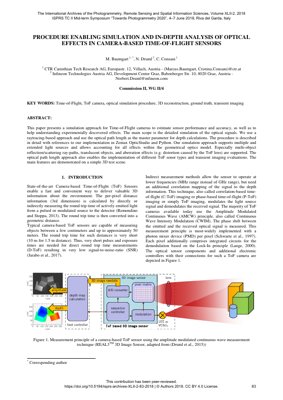
ToF sensors measure distance by calculating the round-trip time of light. Two primary techniques dominate:
2.1 Direct Time-of-Flight (D-ToF)
Measures the time delay of a short light pulse directly. It offers high precision but suffers from low signal-to-noise ratio (SNR) due to the need for GHz-speed electronics and very short integration times (e.g., 10 ns for 1.5 m).
2.2 Correlation-Based Time-of-Flight (C-ToF/P-ToF)
The prevalent method in consumer devices. It uses amplitude-modulated continuous wave (AMCW) light. Distance is derived from the phase shift ($\phi$) between emitted and received signals. The depth ($d$) is calculated as: $d = \frac{c \cdot \phi}{4 \pi f_{mod}}$, where $c$ is the speed of light and $f_{mod}$ is the modulation frequency. This method operates in the MHz range, easing electronic requirements but introducing ambiguity at distances exceeding the modulation wavelength.
3. Proposed Simulation Procedure
The core contribution is a simulation pipeline that treats optical path length as the master parameter for depth calculation.
3.1 Raytracing-Based Optical Path Length Approach
Instead of simulating electrical signals, the method traces individual rays from the source (e.g., VCSEL), through the scene (including multiple reflections, scattering, and translucency), and into the sensor lens. The total optical path length (OPL) for each ray is computed as $OPL = \int n(s) \, ds$, where $n$ is the refractive index and $s$ is the geometric path. This OPL directly correlates to the time-of-flight.
3.2 Implementation in Zemax OpticStudio and Python
The optical propagation and lens effects (distortion, aberration) are simulated in Zemax OpticStudio. The results, including ray data and OPL, are exported and processed in a Python environment. Python handles the scene geometry, material properties, sensor modeling (e.g., PMD pixel response), and the final correlation/depth calculation, creating a flexible and extensible workflow.
3.3 Supported Optical Effects
- Multi-Path Interference (MPI): Simulates rays that bounce between multiple objects before reaching the sensor, a major source of depth error.
- Translucent Materials: Models subsurface scattering within objects like plastics or skin.
- Lens Aberrations: Incorporates real lens distortions that smear the optical signal across pixels.
- Extended & Multiple Light Sources: Accurately models complex illumination patterns, not just point sources.
Key Simulation Capabilities
Multi-path reflection, Subsurface scattering, Lens distortion, Complex illumination
Implementation Tools
Zemax OpticStudio (Optics), Python (Processing & Analysis)
4. Technical Details & Mathematical Foundation
The depth value $z$ for a correlation-based ToF pixel is derived from the phase shift of four correlated samples ($A_0$, $A_1$, $A_2$, $A_3$), typically acquired with 90-degree phase shifts:
$$\phi = \arctan\left(\frac{A_3 - A_1}{A_0 - A_2}\right)$$
$$z = \frac{c}{4\pi f_{mod}} \phi$$
The simulation generates these correlated samples $A_i$ by integrating the incident optical power, modulated by the simulated optical path delay, over the pixel's integration time. The optical power for a ray bundle reaching a pixel is weighted by its simulated intensity and path length.
5. Experimental Results & Demonstration
The paper demonstrates the procedure on a simple 3D test scene. While specific quantitative error metrics are not detailed in the provided excerpt, the demonstration likely showcases:
- Ground Truth vs. Simulated Depth Map: A visual and quantitative comparison showing the accuracy of the simulation in reproducing depth values.
- Artifact Visualization: Images highlighting where multi-path interference (MPI) causes erroneous depth measurements (e.g., depth errors in corners or behind translucent objects).
- Effect of Lens Distortion: Illustrating how non-ideal optics blur depth edges and reduce effective resolution.
Chart Implication: A successful demonstration would show a high correlation between simulated depth errors and those measured from a physical sensor viewing the same scene, validating the model's predictive power for problematic optical conditions.
6. Analysis Framework: Core Insight & Logical Flow
Core Insight: The paper's fundamental breakthrough isn't a new algorithm, but a philosophical shift in ToF simulation. Instead of treating the sensor as a black box with an ideal depth-output function, they model it as a physical optical system first. The "optical path length as master parameter" approach forces the simulation to respect the laws of geometrical optics, making it a first-principles tool rather than a fitted model. This is akin to the shift from empirical image processing to physics-based rendering in computer graphics.
Logical Flow: The authors' argument is methodical: 1) Identify that real-world optical effects (MPI, scattering) are the primary limiters of ToF accuracy. 2) Argue that existing electrical or simplified optical models cannot capture these. 3) Propose a raytracing framework as the minimal-complexity solution that can capture them. 4) Validate by showing it can simulate the very effects that plague real sensors. The logic is compelling because it attacks the problem at its root cause.
7. Strengths, Flaws & Actionable Insights
Strengths:
- Predictive Power for Nasty Artifacts: This is its killer feature. By capturing MPI and scattering, it can predict depth errors in complex scenes (e.g., indoor corners, automotive interiors) before building a sensor, saving millions in design iterations.
- Toolchain Agnosticism: Using Zemax and Python makes it accessible. The concept can be ported to Blender/Cycles or NVIDIA OptiX for faster, GPU-accelerated raytracing.
- Foundation for AI Training: It can generate massive, perfectly labeled datasets of depth maps with corresponding error maps—gold dust for training AI models to correct ToF errors, similar to how CycleGAN-style networks learn domain translation.
Glaring Flaws & Omissions:
- Computational Cost Black Box: The paper is suspiciously quiet on runtime. Raytracing complex scenes with millions of rays per frame is brutally slow. Without significant optimization or approximations, this is a research tool, not a design tool.
- Noise Model is Hand-Waved: They mention noise but don't integrate a comprehensive sensor noise model (shot noise, read noise, dark current). This is a major shortcoming; noise is what makes MPI and low-signal problems catastrophic.
- Validation is Light: A "simple 3D test scene" is not enough. Where is the quantitative comparison against a high-precision reference like a laser scanner for a standardized, complex scene?
Actionable Insights:
- For Researchers: Use this framework to generate "error maps" for new scenes. Focus on using the results to train lightweight neural networks that can correct these errors in real-time on the sensor, moving the heavy lifting from simulation-time to inference-time.
- For Engineers: Integrate a simplified, real-time capable version of this model into sensor design software. Use it to run rapid "what-if" analyses on lens design and illumination patterns to minimize MPI susceptibility from the start.
- Next Paper to Write: "A Differentiable ToF Sensor Simulator for End-to-End Optimization." Combine this raytracing approach with differentiable rendering techniques. This would allow you to not just simulate errors, but to optimize the sensor hardware (lens shape, modulation pattern) directly by backpropagating through the simulation to minimize a depth error loss function.
8. Application Outlook & Future Directions
The simulation framework opens doors in several key areas:
- Automotive LiDAR/ToF: Simulating depth perception in adverse conditions (rain, fog, multi-car interference) to develop robust algorithms for autonomous vehicles.
- Biometrics & Healthcare: Modeling light interaction with human tissue for applications like vein imaging, respiratory monitoring, or non-contact heart rate detection, where subsurface scattering is dominant.
- Augmented/Virtual Reality (AR/VR): Optimizing inside-out tracking sensors for performance in diverse, cluttered home environments full of multi-path reflections.
- Industrial Metrology: Designing ToF systems for precise measurement of complex, shiny, or translucent industrial parts.
Future Research must focus on bridging the gap to real-time performance through importance sampling (prioritizing rays likely to cause MPI) and reduced-physics models, and on tight integration with comprehensive electronic noise simulation.
9. References
- Baumgart, M., Druml, N., & Consani, C. (2018). Procedure enabling simulation and in-depth analysis of optical effects in camera-based time-of-flight sensors. The International Archives of the Photogrammetry, Remote Sensing and Spatial Information Sciences, XLII-2, 83-90.
- Lange, R. (2000). 3D Time-of-Flight distance measurement with custom solid-state image sensors in CMOS/CCD-technology. PhD Thesis, University of Siegen.
- Schwarte, R., et al. (1997). New electro-optical mixing and correlating sensor: facilities and applications of the photonic mixer device (PMD). Proc. SPIE, 3100.
- Jarabo, A., et al. (2017). A Framework for Transient Rendering. ACM Computing Surveys. (External source on transient imaging)
- Remondino, F., & Stoppa, D. (Eds.). (2013). TOF Range-Imaging Cameras. Springer. (External authoritative book on ToF)
- Zhu, J.Y., et al. (2017). Unpaired Image-to-Image Translation using Cycle-Consistent Adversarial Networks. IEEE ICCV. (CycleGAN reference for AI-based error correction concept)