1. Introduction
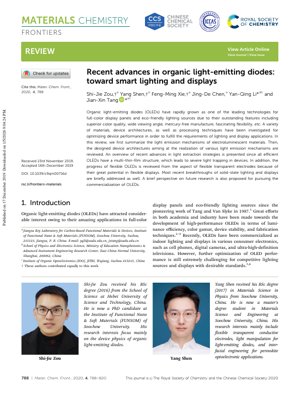
Organic light-emitting diodes (OLEDs) represent a transformative technology in optoelectronics, emerging as a leading solution for full-color displays and eco-friendly lighting. Since the pioneering work of Tang and Van Slyke in 1987, OLEDs have evolved significantly, driven by their superior color quality, wide viewing angles, flexibility, and mercury-free manufacturing process. This review synthesizes recent advancements across materials, device physics, and engineering strategies, charting the path from fundamental research to commercial smart lighting and display applications.
2. Light Emission Mechanisms
The efficiency of an OLED is fundamentally governed by the electroluminescent material's ability to convert electrical energy into light. Three primary mechanisms dominate current research.
2.1 Fluorescence
Conventional fluorescence utilizes singlet excitons, but is limited by a maximum internal quantum efficiency (IQE) of 25%, as only 25% of electrically generated excitons are singlets according to spin statistics.
2.2 Phosphorescence
Phosphorescent OLEDs (PHOLEDs) employ heavy metal complexes (e.g., Iridium, Platinum) to facilitate intersystem crossing, harvesting both singlet and triplet excitons. This enables up to 100% IQE but often at the cost of efficiency roll-off at high brightness and material cost.
2.3 Thermally Activated Delayed Fluorescence (TADF)
TADF materials achieve 100% IQE without heavy metals by having a small energy gap ($\Delta E_{ST}$) between singlet and triplet states, allowing reverse intersystem crossing (RISC). The RISC rate ($k_{RISC}$) is critical and given by: $k_{RISC} \propto \exp(-\Delta E_{ST}/kT)$.
3. Device Architectures
Optimizing the stack of organic layers is crucial for balancing charge injection, transport, recombination, and light outcoupling.
3.1 Conventional Structures
The basic structure comprises: Anode (ITO) / Hole Injection Layer (HIL) / Hole Transport Layer (HTL) / Emissive Layer (EML) / Electron Transport Layer (ETL) / Cathode. The energy level alignment at each interface is paramount to minimize injection barriers.
3.2 Tandem OLEDs
Tandem structures connect multiple electroluminescent units in series via charge generation layers (CGLs). This architecture multiplies luminance at a given current density, significantly enhancing lifetime and efficiency. The total voltage is roughly the sum of individual unit voltages.
3.3 Stacked and Microcavity Structures
Precise control of layer thicknesses creates microcavity effects, enhancing light emission in specific directions and wavelengths, which is particularly beneficial for display pixels.
4. Light Extraction Strategies
A major bottleneck is the trapping of ~50-80% of generated light within the device due to total internal reflection at organic/ITO/glass interfaces.
4.1 Internal Light Trapping
Photons are lost to waveguide modes within the organic/ITO layers and substrate modes within the glass. The fraction of light coupled into each mode depends on the refractive indices: $n_{org} \approx 1.7-1.8$, $n_{ITO} \approx 1.9-2.0$, $n_{glass} \approx 1.5$.
4.2 External Extraction Techniques
Strategies include:
- Scattering Layers: Diffuse surfaces or embedded scattering particles.
- Microlens Arrays: Attached to the substrate to increase the escape cone.
- Patterned Substrates/Internal Structures: Bragg gratings or photonic crystals to redirect trapped light.
5. Flexible OLEDs and Transparent Electrodes
The future of displays lies in flexibility. This hinges on developing robust, flexible transparent conductive electrodes (FTCEs) to replace brittle indium tin oxide (ITO). Promising alternatives include:
- Conductive Polymers: PEDOT:PSS, with tunable conductivity but environmental stability concerns.
- Metal Nanowire Meshes: Silver nanowires offer high conductivity and flexibility, but can have haze and roughness issues.
- Graphene and Carbon Nanotubes: Excellent mechanical properties, but achieving uniform, high-conductivity films at scale is challenging.
- Thin Metal Films: Ultra-thin Ag or Ag-based composites with dielectric layers for anti-reflection.
6. Applications and Commercialization
6.1 Solid-State Lighting
OLED panels offer diffuse, glare-free, and tunable white light for architectural and specialty lighting. The key metrics are luminous efficacy (lm/W), color rendering index (CRI > 90 for high-quality lighting), and lifetime (LT70 > 50,000 hours).
6.2 Display Technologies
OLEDs dominate the premium smartphone market and are advancing in TVs, laptops, and automotive displays. Advantages include perfect black levels (infinite contrast), fast response time, and form factor freedom (flexible, rollable, transparent).
7. Future Perspectives
The review identifies key challenges: further improving blue emitter lifetime, reducing manufacturing costs (especially for large areas), and developing encapsulation technologies for long-lived flexible devices. The integration of OLEDs with sensors and circuits for "smart" interactive surfaces is a promising frontier.
8. Original Analysis & Expert Commentary
Core Insight: The OLED field is at a critical inflection point, transitioning from a display-centric technology to a foundational platform for next-generation human-centric lighting and intelligent surfaces. The real battle is no longer just about color purity or efficiency—it's about system-level integration and manufacturing economics.
Logical Flow: Zou et al. correctly trace the evolution from materials (TADF as a cost-effective 100% IQE path) to device optics (solving the light extraction problem) to form factor (flexibility). However, the review underweights the seismic shift towards solution processing (e.g., inkjet printing) for large-area displays and lighting, a trend underscored by companies like Kateeva and JOLED. The industry's pivot, as noted in reports from IDTechEx and the OLED Association, is towards reducing the cost-per-nits and enabling new form factors, not just chasing peak EQE.
Strengths & Flaws: The paper's strength is its holistic view, connecting fundamental physics to engineering. A significant flaw, common in academic reviews, is the minimal discussion of reliability and degradation mechanisms. For commercialization, a 5% drop in luminance (LT95) over 10,000 hours is more consequential than a 5% gain in peak efficiency. The "green gap" and blue emitter stability—particularly for TADF—remain the Achilles' heel, a point extensively documented in the work of Adachi and others.
Actionable Insights: For investors and R&D managers: 1) Bet on TADF and Hybrid Materials: The future is metal-free or minimally metal-based systems for cost and sustainability. 2) Focus on Outcoupling as a Multiplicative Factor: A 2x gain in light extraction improves every device metric and is often cheaper than developing a new emitter. 3) Look Beyond Displays: The high-value niche for OLEDs in the next 5 years is in biomedical devices (wearable phototherapy), automotive interiors (conformal lighting), and ultra-thin, lightweight lighting for aerospace. The convergence with perovskite LED (PeLED) research, as seen in parallel work from groups like that of Prof. Richard Friend at Cambridge, suggests a future of hybrid organic-inorganic systems that could finally crack the cost-performance barrier for general lighting.
9. Technical Details & Experimental Results
Key Formula - External Quantum Efficiency (EQE): The overall device efficiency is given by: $$EQE = \gamma \times \eta_{r} \times \Phi_{PL} \times \eta_{out}$$ where $\gamma$ is the charge balance factor, $\eta_{r}$ is the exciton formation ratio (25% for fluorescence, ~100% for phosphorescence/TADF), $\Phi_{PL}$ is the photoluminescence quantum yield of the emitter, and $\eta_{out}$ is the light outcoupling efficiency (typically 20-30%).
Experimental Results & Chart Description: The review cites state-of-the-art devices achieving:
- Green TADF OLEDs: EQE > 35% with CIE coordinates near (0.30, 0.65).
- Blue Phosphorescent OLEDs: LT70 (time to 70% initial luminance) at 1000 cd/m² exceeding 500 hours, with EQE ~25%. This remains a critical benchmark for display applications.
- Flexible White OLEDs: For lighting, flexible devices on PET substrates with a luminous efficacy of 80 lm/W and a CRI of 85 have been demonstrated, showcasing progress towards roll-to-roll manufacturing.
10. Analysis Framework & Case Study
Framework: The OLED Technology Readiness & Value Matrix
To evaluate any OLED advancement, we propose a two-axis framework:
- X-axis: Technology Readiness Level (TRL 1-9): From basic research (TRL 1-3) to commercial product (TRL 9).
- Y-axis: Value Multiplier: The potential impact on system cost, performance, or new market creation (Low/Medium/High).
Case Study: Applying the Framework
Technology: Silver Nanowire (AgNW) Flexible Electrodes.
Analysis:
- TRL: 7-8. Integrated into prototype flexible displays and lighting panels by several companies.
- Value Multiplier: HIGH. Enables the core feature of flexibility, reduces dependence on scarce indium, and is compatible with low-temperature, roll-to-roll processing, lowering manufacturing cost.
- Verdict: A high-priority development area. The main hurdles are not fundamental but engineering: improving long-term stability under bending and humidity, and reducing electrode roughness to prevent device shorts.
11. Future Applications & Directions
- Bio-Integrated Optoelectronics: Ultra-thin, flexible OLEDs for implantable or wearable phototherapeutic devices, e.g., for targeted treatment of jaundice or seasonal affective disorder.
- Transparent and Interactive Surfaces: Windows that double as displays or light sources, and car dashboards with seamless, conformal lighting and information display.
- Neuromorphic Displays/Lighting: Integrating OLEDs with thin-film sensors and processors to create surfaces that adapt color temperature and brightness based on occupant circadian rhythms or task, moving beyond static "smart" to truly responsive environments. Research in this area is being pioneered at institutes like MIT's Media Lab and the Holst Centre.
- Sustainable Manufacturing: A major future direction is the development of fully solution-processed, roll-to-roll manufactured OLEDs using green solvents, driving down cost and environmental impact for large-area lighting applications.
12. References
- Tang, C. W. & VanSlyke, S. A. Organic electroluminescent diodes. Appl. Phys. Lett. 51, 913 (1987). (The foundational work).
- Uoyama, H. et al. Highly efficient organic light-emitting diodes from delayed fluorescence. Nature 492, 234–238 (2012). (Seminal TADF paper).
- IDTechEx. OLED Display Forecasts, Players and Opportunities 2024-2034. (Market analysis report).
- Adachi, C. Third-generation organic electroluminescence materials. Jpn. J. Appl. Phys. 53, 060101 (2014). (Review on TADF and device physics).
- Friend, R. H. et al. Electroluminescence in conjugated polymers. Nature 397, 121–128 (1999). (Key work on polymer LEDs).
- The OLED Association. https://www.oled-a.org (Industry consortium website for latest commercial trends).
- MIT Media Lab. Research on responsive environments and human-centric lighting.
- Zou, S.-J. et al. Recent advances in organic light-emitting diodes: toward smart lighting and displays. Mater. Chem. Front. 4, 788–820 (2020). (The reviewed paper).