1. Introduction
High-quality, consistent lighting estimation is a cornerstone for photorealistic Augmented Reality (AR) applications like scene enhancement and telepresence. The paper "Spatiotemporally Consistent HDR Indoor Lighting Estimation" tackles the significant challenge of predicting lighting from sparse, incomplete inputs typical of mobile devices—often just a single Low Dynamic Range (LDR) image covering about 6% of the panoramic scene. The core problem is to hallucinate missing High Dynamic Range (HDR) information and invisible scene parts (like light sources outside the frame) while ensuring predictions are consistent across different spatial locations in an image and over time in a video sequence. This work proposes the first framework to achieve this dual consistency, enabling realistic rendering of virtual objects with complex materials like mirrors and specular surfaces.
2. Methodology
The proposed framework is a multi-component, physically-motivated deep learning system designed to predict lighting from an LDR image (and optional depth) or an LDR video sequence.
2.1. Spherical Gaussian Lighting Volume (SGLV)
The core representation is a 3D volume where each voxel stores parameters for a set of Spherical Gaussians (SGs), which are an efficient approximation for complex lighting. An SG is defined as: $G(\mathbf{v}; \mathbf{\mu}, \lambda, a) = a \cdot e^{\lambda(\mathbf{\mu} \cdot \mathbf{v} - 1)}$, where $\mathbf{\mu}$ is the lobe axis, $\lambda$ is the lobe sharpness, and $a$ is the lobe amplitude. The SGLV compactly represents the lighting field throughout the scene's 3D space.
2.2. 3D Encoder-Decoder Architecture
A tailored 3D convolutional network takes the input LDR image (and depth map, if available) and constructs the SGLV. The encoder extracts multi-scale features, which the decoder uses to progressively upsample and predict the SG parameters (axis, sharpness, amplitude) for each voxel in the volume.
2.3. Volume Ray Tracing for Spatial Consistency
To predict lighting at any arbitrary image position (e.g., where a virtual object is placed), the framework performs volume ray tracing through the SGLV. For a given 3D point and viewing direction, it samples the SGLV along the ray and aggregates the SG parameters. This ensures that lighting predictions are physically grounded and vary smoothly and consistently across spatial locations, respecting scene geometry.
2.4. Hybrid Blending Network for Environment Maps
The ray-traced SG parameters are decoded into a detailed HDR environment map. A hybrid blending network combines a coarse, globally consistent prediction from the SGLV with learned, high-frequency details to produce a final environment map that includes fine reflections and invisible light sources.
2.5. In-Network Monte-Carlo Rendering Layer
A differentiable Monte-Carlo rendering layer is integrated into the training pipeline. It renders virtual objects with the predicted lighting and compares the result to ground truth renders. This end-to-end photometric loss directly optimizes for the final goal—photorealistic object insertion—and provides a strong supervisory signal, similar in spirit to the adversarial and cycle-consistency losses that propelled image-to-image translation models like CycleGAN [Zhu et al., 2017].
2.6. Recurrent Neural Networks for Temporal Consistency
When the input is a video sequence, a Recurrent Neural Network (RNN) module is employed. It maintains a hidden state that aggregates information from past frames. This allows the framework to progressively refine its lighting estimate as it observes more of the scene over time, while the RNN's memory ensures the refinement is smooth and temporally consistent, avoiding flickering or jarring jumps in predicted lighting.
3. Enhanced OpenRooms Dataset
To train such a data-hungry model, the authors significantly augmented the public OpenRooms dataset. The enhanced version includes approximately 360,000 HDR environment maps at much higher resolution and 38,000 video sequences, all rendered using GPU-accelerated path tracing for physical accuracy. This large-scale, high-quality synthetic dataset was crucial for the model's success.
Dataset Statistics
- HDR Environment Maps: ~360,000
- Video Sequences: ~38,000
- Rendering Method: GPU-based Path Tracing
- Primary Use: Training & Benchmarking Indoor Lighting Estimation Models
4. Experiments & Results
4.1. Quantitative Evaluation
The framework was evaluated against state-of-the-art single-image and video-based lighting estimation methods using standard metrics like Mean Squared Error (MSE) and Structural Similarity Index (SSIM) on HDR environment maps, as well as perceptual metrics on rendered object insertions. The proposed method consistently outperformed all baselines in predicting accurate lighting, both spatially and temporally.
4.2. Qualitative Evaluation & Visual Results
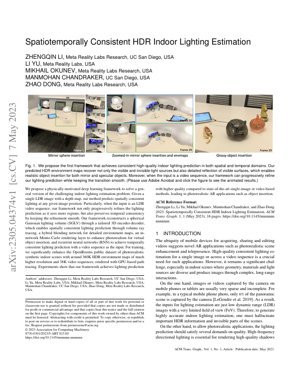
As shown in Figure 1 of the paper, the method successfully recovers both visible and invisible light sources and detailed reflections from visible surfaces. This enables highly realistic insertion of virtual objects with challenging materials. For video inputs, the results demonstrate smooth progression and stability over time, with no flickering.
Chart/Figure Description (Based on Fig. 1 & 2): Figure 1 provides a compelling visual summary, comparing object insertions using lighting from different methods. The authors' results show correct specular highlights, soft shadows, and color bleeding that match the real scene, unlike competitors whose insertions appear flat, incorrectly colored, or lack coherent shadows. Figure 2 illustrates the overall framework architecture, showing the flow from input image/depth to SGLV, through ray tracing and the blending network, to the final HDR environment map and rendered object.
4.3. Ablation Studies
Ablation studies confirmed the importance of each component: removing the SGLV and volume ray tracing harmed spatial consistency; removing the in-network renderer reduced photorealism of insertions; and disabling the RNN led to temporally inconsistent, flickering predictions in videos.
5. Technical Analysis & Core Insights
Core Insight
This paper isn't just another incremental improvement in lighting estimation; it's a paradigm shift towards treating lighting as a spatiotemporal field rather than a static, view-independent panorama. The authors correctly identify that for AR to feel "real," virtual objects must interact with light consistently as the user or object moves. Their key insight is to leverage a 3D volumetric lighting representation (SGLV) as the central mediating data structure. This is the masterstroke—it bridges the gap between the 2D image domain and the 3D physical world, enabling both spatial reasoning via ray tracing and temporal smoothing via sequence modeling. It moves beyond the limitations of methods that directly regress an environment map from a 2D CNN, which inherently struggle with spatial coherence.
Logical Flow
The architectural logic is elegant and follows a clear physical simulation pipeline, which is why it works so well: 2D Input -> 3D Scene Understanding (SGLV) -> Physical Query (Ray Tracing) -> 2D Output (Env Map/Render). The 3D encoder-decoder builds an implicit model of the scene's lighting distribution. The volume ray tracing operator acts as a differentiable, geometry-aware query mechanism. The hybrid network adds the necessary high-frequency details lost in the volumetric discretization. Finally, the in-network Monte-Carlo renderer closes the loop, aligning the learning objective with the final perceptual task. For video, the RNN simply updates the latent 3D representation over time, making temporal consistency a natural byproduct.
Strengths & Flaws
Strengths: The dual consistency achievement is a landmark. The use of a physically-based representation (SGLV+Ray Tracing) grants it strong inductive biases, leading to better generalization than purely data-driven approaches. The enhanced OpenRooms dataset is a major contribution to the community. The integration of the rendering loss is smart, akin to the "task-aware" training seen in modern vision models.
Flaws & Questions: The elephant in the room is computational cost. Building and querying a 3D volume is heavy. While feasible for research, real-time performance on mobile AR devices remains a significant hurdle. The reliance on synthetic data (OpenRooms) is a double-edged sword; while it provides perfect ground truth, the sim-to-real gap for complex, messy real-world interiors is unproven. The method also assumes a depth map is available, which adds a dependency on another sensor or estimation algorithm. How does it perform with noisy or missing depth?
Actionable Insights
1. For Researchers: The SGLV concept is ripe for exploration. Can it be made more efficient with sparse or hierarchical representations? Can this framework be adapted for outdoor lighting estimation? 2. For Engineers/Product Teams: The immediate application is in high-fidelity AR content creation and professional visualization. For consumer mobile AR, consider a two-tier system: a lightweight, fast estimator for real-time tracking, and this method as a backend service for generating premium, photorealistic effects when the user pauses. 3. Dataset Strategy: The success underscores the need for large-scale, high-quality labeled data in graphics vision. Investing in tools for efficient synthetic data generation (a trend supported by NVIDIA's Omniverse and others) is crucial for advancing the field. 4. Hardware Co-design: This work pushes the boundary of what's needed for believable AR. It's a clear signal to chipmakers (Apple, Qualcomm) that on-device neural rendering and 3D inference capabilities are not a luxury but a necessity for the next generation of AR experiences.
In conclusion, this paper sets a new state-of-the-art by rigorously addressing the core challenges of consistency. It's a significant step from "pretty good" lighting to lighting that can truly fool the eye in dynamic AR scenarios. The remaining challenges are largely engineering: efficiency, robustness to real-world data, and seamless integration into the device pipeline.
6. Application Examples & Framework
Example Case: Virtual Furniture Placement in AR
An interior design app uses this framework. A user points their tablet at a living room corner.
- Input: The app captures an LDR video stream and estimates depth using the device's LiDAR/sensors.
- Processing: The framework's network processes the first frame, constructing an initial SGLV and predicting an HDR lighting environment for the center of the screen.
- Interaction: The user selects a virtual sofa to place in the corner. The app uses volume ray tracing to query the SGLV at the sofa's 3D location, obtaining a spatially correct lighting estimate for that specific spot (which accounts for a nearby window not directly visible in the initial frame).
- Rendering: The sofa is rendered with the queried lighting using the Monte-Carlo renderer, showing accurate soft shadows from the window, specular highlights on leather parts, and color bleed from the nearby rug.
- Refinement: As the user moves the tablet around the room (video sequence), the RNN updates the SGLV, refining the lighting model. The sofa's appearance updates smoothly and consistently, maintaining correct lighting interaction from all new viewpoints without flickering.
This example demonstrates the core benefits: spatial consistency (correct lighting at the sofa's location), temporal consistency (smooth updates), and photorealism (complex material rendering).
7. Future Applications & Directions
- Next-Generation AR/VR Telepresence: Enabling realistic avatars or remote participants to be lit consistently with the local environment in real-time communication, dramatically improving immersion.
- Film & Game Post-Production: Allowing visual effects artists to quickly estimate and replicate on-set lighting for seamless integration of CGI elements into live-action plates, even from limited reference footage.
- Architectural Visualization & Real Estate: Creating interactive walkthroughs where lighting on virtual furnishings updates photorealistically as a client explores a 3D model of an unfinished space.
- Robotics & Embodied AI: Providing robots with a richer understanding of scene illumination, aiding in material identification, navigation, and interaction planning.
- Future Research Directions: 1) Efficiency: Exploring knowledge distillation, neural compression of the SGLV, or specialized hardware accelerators. 2) Robustness: Training on hybrid synthetic-real datasets or using self-supervised techniques to bridge the sim-to-real gap. 3) Generalization: Extending the framework to dynamic lighting (e.g., turning lights on/off, moving light sources) and outdoor environments. 4) Unified Models: Jointly estimating lighting, geometry, and material properties from video in an end-to-end manner.
8. References
- Li, Z., Yu, L., Okunev, M., Chandraker, M., & Dong, Z. (2023). Spatiotemporally Consistent HDR Indoor Lighting Estimation. ACM Transactions on Graphics (TOG).
- Zhu, J.-Y., Park, T., Isola, P., & Efros, A. A. (2017). Unpaired Image-to-Image Translation using Cycle-Consistent Adversarial Networks. Proceedings of the IEEE International Conference on Computer Vision (ICCV).
- LeGendre, C., Ma, W., Fyffe, G., Flynn, J., Charbonnel, L., Busch, J., & Debevec, P. (2019). DeepLight: Learning Illumination for Unconstrained Mobile Mixed Reality. Proceedings of the IEEE/CVF Conference on Computer Vision and Pattern Recognition (CVPR).
- OpenRooms Dataset. (n.d.). An open dataset for indoor scene understanding. Retrieved from the project's official website or academic repository.
- Mildenhall, B., Srinivasan, P. P., Tancik, M., Barron, J. T., Ramamoorthi, R., & Ng, R. (2020). NeRF: Representing Scenes as Neural Radiance Fields for View Synthesis. Communications of the ACM. (Cited for conceptual connection to 3D scene representation).