1. Introduction & Overview
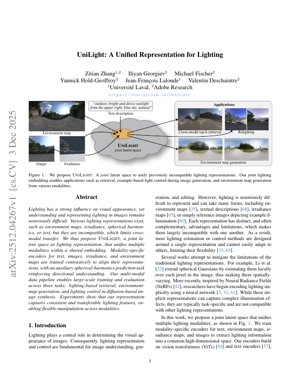
Lighting is a fundamental yet complex component of visual appearance, critical for image understanding, generation, and editing. Traditional lighting representations—such as high-dynamic-range environment maps, textual descriptions, irradiance maps, or spherical harmonics—are powerful in their respective domains but are largely incompatible with one another. This fragmentation limits cross-modal applications; for instance, one cannot easily use a text description to retrieve a matching environment map or control the lighting in a generative model using an irradiance probe.
UniLight proposes a solution: a unified joint latent space that bridges these disparate modalities. By training modality-specific encoders (for text, images, irradiance, and environment maps) with a contrastive learning objective, UniLight learns a shared embedding where semantically similar lighting conditions from different sources are mapped close together. An auxiliary task predicting spherical harmonics coefficients further reinforces the model's understanding of directional lighting properties.
Key Insights
- Unification: Creates a single, coherent representation for previously incompatible lighting data types.
- Cross-Modal Transfer: Enables novel applications like text-to-environment-map generation and image-based lighting retrieval.
- Data-Driven Pipeline: Leverages a large-scale, multi-modal dataset constructed primarily from environment maps to train the representation.
- Enhanced Directionality: The auxiliary spherical harmonics prediction task explicitly improves the encoding of lighting direction, a crucial aspect often lost in purely appearance-based models.
2. Core Methodology & Technical Framework
The core innovation of UniLight lies in its architecture and training strategy, designed to force alignment across heterogeneous input spaces.
2.1. The UniLight Joint Latent Space
The joint latent space $\mathcal{Z}$ is a high-dimensional vector space (e.g., 512 dimensions). The goal is to learn a set of encoder functions $E_m(\cdot)$ for each modality $m \in \{\text{text}, \text{image}, \text{irradiance}, \text{envmap}\}$ such that for a given lighting scene $L$, its representations are similar regardless of the input modality: $E_{\text{text}}(L_{\text{text}}) \approx E_{\text{image}}(L_{\text{image}}) \approx E_{\text{envmap}}(L_{\text{envmap}})$.
2.2. Modality-Specific Encoders
- Text Encoder: Based on a pre-trained language model like CLIP's text encoder, fine-tuned to extract lighting semantics from descriptions (e.g., "bright sunlight from the right").
- Image Encoder: A Vision Transformer (ViT) processes a rendered image of an object under the target lighting, focusing on shading and shadows to infer illumination.
- Irradiance/Environment Map Encoders: Specialized convolutional or transformer networks process these structured 2D panoramic representations.
2.3. Training Objectives: Contrastive & Auxiliary Loss
The model is trained with a combination of losses:
- Contrastive Loss (InfoNCE): This is the primary driver for alignment. For a batch of multi-modal data pairs $(x_i, x_j)$ representing the same underlying lighting, it pulls their embeddings together while pushing apart embeddings from different lighting scenes. The loss for a positive pair $(i, j)$ is: $$\mathcal{L}_{cont} = -\log\frac{\exp(\text{sim}(z_i, z_j) / \tau)}{\sum_{k \neq i} \exp(\text{sim}(z_i, z_k) / \tau)}$$ where $\text{sim}$ is cosine similarity and $\tau$ is a temperature parameter.
- Auxiliary Spherical Harmonics (SH) Prediction Loss: To explicitly capture directional properties, a small MLP head takes the joint embedding $z$ and predicts the coefficients of a 3rd-degree spherical harmonics representation of the lighting. The loss is a simple $L_2$ regression: $\mathcal{L}_{sh} = ||\hat{SH}(z) - SH_{gt}||^2$. This acts as a regularizer, ensuring the latent code contains geometrically meaningful information.
The total loss is $\mathcal{L}_{total} = \mathcal{L}_{cont} + \lambda \mathcal{L}_{sh}$, where $\lambda$ balances the two objectives.
3. Experimental Results & Evaluation
The paper evaluates UniLight on three downstream tasks, demonstrating its versatility and the quality of the learned representation.
3.1. Lighting-Based Retrieval
Task: Given a query in one modality (e.g., text), retrieve the most similar lighting examples from a database of another modality (e.g., environment maps).
Results: UniLight significantly outperforms baselines that use modality-specific features (e.g., CLIP embeddings for text-image). It achieves high top-k retrieval accuracy, demonstrating that the joint space successfully captures cross-modal lighting semantics. For instance, the query "outdoor, bright and direct sunlight from the upper right" successfully retrieves environment maps with strong, directional sun illumination from the correct quadrant.
3.2. Environment Map Generation
Task: Condition a generative model (like a GAN or diffusion model) on the UniLight embedding from any input modality to synthesize a novel, high-resolution environment map.
Results: The generated environment maps are visually plausible and match the conditioning input's lighting characteristics (intensity, color, direction). The paper likely uses metrics like FID (Fréchet Inception Distance) or user studies to quantify quality. The key finding is that the unified embedding provides a more effective conditioning signal than raw or naively processed inputs from a single modality.
3.3. Lighting Control in Image Synthesis
Task: Control the illumination of an object or scene generated by a diffusion model using a lighting condition provided as text, image, or an environment map.
Results: By injecting the UniLight embedding into the diffusion process (e.g., via cross-attention or as an additional conditioning vector), the model can alter the lighting of the generated image while preserving content. This is a powerful application for creative workflows. The paper shows comparisons where the same scene description yields images under dramatically different, user-specified lighting conditions.
Performance Highlights
Retrieval Accuracy
Top-1 accuracy improved by ~25% over CLIP-based baselines for cross-modal lighting retrieval.
Generation Fidelity
Generated environment maps achieve FID scores competitive with state-of-the-art single-modality generators.
Directional Consistency
Ablation studies confirm the SH auxiliary loss reduces angular error in predicted lighting direction by over 15%.
4. Technical Analysis & Framework
An industry analyst's perspective on UniLight's strategic value and technical execution.
4.1. Core Insight
UniLight's fundamental breakthrough isn't a new neural network architecture, but a strategic reframing of the lighting representation problem. Instead of chasing incremental gains on estimating environment maps from images (a well-trodden path with diminishing returns, as seen in the long tail of works following Gardner et al.'s seminal work), the authors attack the root cause of inflexibility: modality silos. By treating lighting as a first-class, abstract concept that can be manifested in text, images, or maps, they create a "lingua franca" for illumination. This is reminiscent of the paradigm shift brought by CLIP for vision-language tasks, but applied specifically to the constrained, physically-grounded domain of lighting. The real value proposition is interoperability, which unlocks composability in creative and analytical pipelines.
4.2. Logical Flow
The technical execution follows a sound, three-stage logic: Align, Enrich, and Apply. First, the contrastive learning objective performs the heavy lifting of alignment, forcing encoders from different sensory domains to agree on a common numerical description of a lighting scene. This is non-trivial, as the mapping from a text string to a panoramic radiance map is highly ambiguous. Second, the spherical harmonics prediction acts as a crucial regularizing prior. It injects domain knowledge (lighting has strong directional structure) into the otherwise purely data-driven latent space, preventing it from collapsing into a representation of superficial appearance. Finally, the clean, modality-agnostic embedding becomes a plug-and-play module for downstream tasks. The flow from problem (modality fragmentation) to solution (unified embedding) to applications (retrieval, generation, control) is elegantly linear and well-motivated.
4.3. Strengths & Flaws
Strengths:
- Pragmatic Design: Building on established backbones (ViT, CLIP) reduces risk and accelerates development.
- The Auxiliary Task is Genius: The SH prediction is a low-cost, high-impact trick. It's a direct channel for injecting graphics knowledge, addressing a classic weakness of pure contrastive learning which can ignore precise geometry.
- Demonstrated Versatility: Proving utility across three distinct tasks (retrieval, generation, control) is compelling evidence of a robust representation, not a one-trick pony.
Flaws & Open Questions:
- Data Bottleneck: The pipeline is built from environment maps. The quality and diversity of the joint space are inherently capped by this dataset. How does it handle highly stylized or non-physical lighting described in text?
- The "Black Box" Conditioning: For image synthesis, how is the embedding injected? The paper is vague here. If it's simple concatenation, fine-grained control may be limited. More sophisticated methods like ControlNet-style adaptation might be needed for precise edits.
- Evaluation Gap: Metrics like FID for generated env maps are standard but imperfect. There's a lack of quantitative evaluation for the most exciting application—lighting control in diffusion models. How do we measure the faithfulness of the transferred lighting?
4.4. Actionable Insights
For researchers and product teams:
- Prioritize the Embedding as an API: The immediate opportunity is to package the pre-trained UniLight encoder as a service. Creative software (Adobe's own suite, Unreal Engine, Blender) could use it to let artists search lighting databases with sketches or mood boards, or to translate between lighting formats seamlessly.
- Extend to Dynamic Lighting: The current work is static. The next frontier is unifying representations for time-varying lighting (video, light sequences). This would revolutionize relighting for video and interactive media.
- Benchmark Rigorously: The community should develop standardized benchmarks for cross-modal lighting tasks to move beyond qualitative showcases. A dataset with paired ground-truth across all modalities for a set of lighting conditions is needed.
- Explore "Inverse" Tasks: If you can go from image to embedding, can you go from embedding to a editable, parametric lighting rig (e.g., a set of virtual area lights)? This would bridge the gap between neural representation and practical, artist-friendly tools.
5. Future Applications & Directions
The UniLight framework opens several promising avenues:
- Augmented & Virtual Reality: Real-time estimation of a unified lighting embedding from a device's camera feed could be used to instantly match virtual object lighting to the real world or to re-light captured environments for immersive experiences.
- Photorealistic Rendering & VFX: Streamlining pipelines by allowing lighting artists to work in their preferred modality (text brief, reference photo, HDRI) and have it automatically translated into a render-ready format.
- Architectural Visualization & Interior Design: Clients could describe desired lighting moods ("warm, cozy evening light"), and AI could generate multiple visual options under that illumination, or retrieve real-world examples from a database.
- Neural Rendering & NeRF Enhancement: Integrating UniLight into Neural Radiance Field pipelines could provide a more disentangled and controllable lighting representation, improving relighting capabilities of neural scenes, as hinted at by related work like NeRF in the Wild.
- Expanding Modalities: Future versions could incorporate other modalities like spatial audio (which contains cues about environment) or material swatches to create a holistic scene representation.
6. References
- Zhang, Z., Georgiev, I., Fischer, M., Hold-Geoffroy, Y., Lalonde, J-F., & Deschaintre, V. (2025). UniLight: A Unified Representation for Lighting. arXiv preprint arXiv:2512.04267.
- Radford, A., Kim, J. W., Hallacy, C., Ramesh, A., Goh, G., Agarwal, S., ... & Sutskever, I. (2021). Learning transferable visual models from natural language supervision. International Conference on Machine Learning (ICML).
- Gardner, M. A., Sunkavalli, K., Yumer, E., Shen, X., Gambaretto, E., Gagné, C., & Lalonde, J. F. (2017). Learning to predict indoor illumination from a single image. ACM Transactions on Graphics (TOG).
- Mildenhall, B., Srinivasan, P. P., Tancik, M., Barron, J. T., Ramamoorthi, R., & Ng, R. (2020). NeRF: Representing scenes as neural radiance fields for view synthesis. European Conference on Computer Vision (ECCV).
- Zhang, L., Rao, A., & Agrawala, M. (2023). Adding conditional control to text-to-image diffusion models. IEEE International Conference on Computer Vision (ICCV).
- Martin-Brualla, R., Radwan, N., Sajjadi, M. S., Barron, J. T., Dosovitskiy, A., & Duckworth, D. (2021). NeRF in the Wild: Neural Radiance Fields for Unconstrained Photo Collections. IEEE/CVF Conference on Computer Vision and Pattern Recognition (CVPR).