Utangulizi na Muhtasari
Katika video zinazotokana na AI, mwanga ni kipengele cha msingi lakini kinachojulikana kuwa gumu kudhibiti. Ingawa mifano ya kutengeneza video kutoka kwa maandishi imepata maendeleo makubwa, kutenganisha hali ya mwanga na maana ya eneo la tukio na kuitumia kwa usawa, bado ni chango kuu.LumiSculptIt directly addresses this gap. It is a novel framework that introduces precise, user-specified control over light intensity, position, and trajectory into video diffusion models. The system's innovation is twofold: first, it introducesLumiHuman, a novel lightweight dataset containing over 220,000 portrait videos with known lighting parameters, addressing the critical issue of data scarcity. Second, it employs a learnable plug-and-play module that injects lighting conditions into a pre-trained T2V model without compromising other attributes like content or color, enabling the generation of high-fidelity, consistent lighting animations from simple text descriptions and lighting paths.
2. Mbinu ya Msingi: LumiSculpt Framework
Mchakato wa LumiSculpt unalenga kuunganishwa na udhibiti bila mshono. Mtumiaji hutoa maelezo ya maandishi yanayoelezea eneo hilo na maelezo ya chanzo cha mwanga cha kuwazi (k.m., njia, nguvu). Kisha, mfumo hutumia vipengele vyake vilivyofunzwa kutengeneza video ambayo mwanga wake unabadilika kwa usawa kulingana na maagizo ya mtumiaji.
2.1 LumiHuman Dataset
Kikwazo kikuu katika utafiti wa udhibiti wa mwanga ni ukosefu wa data inayofaa. Seti za data zilizopo, kama zile zinazotoka kwenye jukwaa la mwanga (mfanoDigital Emily), zina ubora wa juu lakini ni ngumu, hazifai kwa mafunzo ya uzalishaji. LumiHuman ilijengwa kama njia mbadala inayoweza kubadilika. Inatumia injini ya uchoraji wa kuigiza, ikizalisha video za picha za watu, ambapo vigezo vya mwanga (mwelekeo, rangi, ukali) vinajulikana kwa usahihi, na vinaweza kupangwa upya kwa uhuru kati ya fremu. Njia hii ya "vipengele vya ujenzi" inaruhusu kuiga njia na hali karibu zisizo na kikomo za mwanga, ikitoa data mbalimbali ya mafunzo muhimu kwa mfano kujifunza uwakilishi usiochangamana wa mwanga.
Muhtasari wa Seti ya Data ya LumiHuman
- Kipimo: >220,000 个视频序列
- Yaliyomo: Portrait with Parametric Lighting
- Key Features: Freely combinable frames for generating diverse lighting trajectories
- Construction Method: Rendering using a virtual engine with known lighting parameters
2.2 Lighting Representation and Control
Badala ya kuiga mlinganyo changamano wa usafirishaji wa mwanga, LumiSculpt inatumia njia rahisi lakini yenye ufanisi ya uwakilishi. Hali ya mwanga ya sura moja inabainishwa kama vekta yenye mwelekeo mdogo, ambayo inasimbia sifa za chanzo cha mwanga kinachokisiwa (k.m., kuratibu za tufe kwa mwelekeo, kiwango cha nguvu). Uwakilishi huu umetengwa kwa makusudi kutoka rangi ya uso na umbo la kijiometri, na kuweka uwezo wa mfano kujifunza mwanga.Athari. Udhibiti wa mtumiaji unafanywa kwa kufafanua mlolongo wa vekta hizi za vigezo zinazobadilika kwa wakati—yaani, "wimbo wa mwanga"—ambayo mfano hutumia kama kigezo katika mchakato wa uzalishaji wa video.
2.3 Usanidi wa Moduli ya Plug-and-Play
The core of LumiSculpt is a lightweight neural network module that operates within the denoising U-Net of a latent diffusion model. It takes two inputs: the noisy latent code $z_t$ at timestep $t$, and the lighting parameter vector $l_t$ of the target frame. The module's output is a feature modulation signal (e.g., via spatial feature transformation or cross-attention), which is injected into specific layers of the U-Net. Crucially, this module is trained on the LumiHuman datasetindividually, while the weights of the base T2V model are frozen. This "plug-and-play" strategy ensures that lighting control capability can be added to existing models without costly full retraining, and minimizes interference with the model's pre-existing semantic and stylistic knowledge.
3. Maelezo ya Kiufundi na Fomula za Hisabati
LumiSculpt is built upon the latent diffusion model framework. The goal is to learn a conditional denoising process $\epsilon_\theta(z_t, t, c, l_t)$, where $c$ is the text condition and $l_t$ is the lighting condition at generation step $t$. The lighting control module $M_\phi$ is trained to predict a modulation map $\Delta_t = M_\phi(z_t, l_t)$. This map is used to adjust the features of the base denoiser: $\epsilon_\theta^{adapted} = \epsilon_\theta(z_t, t, c) + \alpha \cdot \Delta_t$, where $\alpha$ is a scaling factor. The training objective is to minimize the reconstruction loss between the generated video frames and the ground-truth rendered frames from LumiHuman, with the lighting condition $l_t$ serving as the key conditioning signal. This forces the module to associate the parameter vector with the corresponding visual lighting effects.
4. Experimental Results and Analysis
Tasnifu hii inaonyesha ufanisi wa LumiSculpt kupitia tathmini kamili.
4.1 Quantitative Metrics
Performance is measured by comparing with baseline T2V models without lighting control using standard video quality metrics (e.g., FVD, FID-Vid). More importantly, custom metrics forlighting consistencywere developed, potentially involving measuring the correlation between the expected light position/intensity trajectory and the perceived lighting across frames in the output video. The results show that LumiSculpt significantly improves adherence to specified lighting conditions while maintaining the base model's quality.
4.2 Tathmini ya Ubora na Utafiti wa Watumiaji
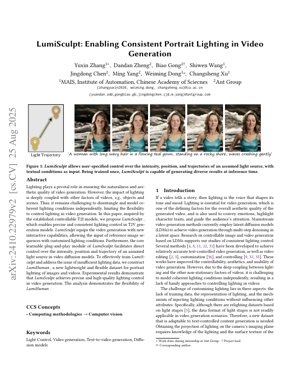
Figure 1 (Conceptual Description) in the PDF shows the generation results. It will depict a sequence of the light source moving smoothly around the subject—for example, from the left side of the face to the right side—with shadows and highlights following the prescribed path, maintaining consistency. User studies may show that users rate the lighting realism, consistency, and controllability of LumiSculpt's output higher compared to attempts using only text prompts (e.g., "light moving from left to right") in standard models, as standard models often produce flickering or semantically incorrect lighting.
4.3 Uchunguzi wa Ablation
Uchunguzi wa ablation umehakikisha umuhimu wa kila sehemu: Kutotumia seti ya data ya LumiHuman kwa mafunzo husababisha uwezo duni wa ujumla; kutumia uwakilishi wa mwanga unaochanganyika zaidi (kama ramani kamili ya mazingira ya HDR) hupunguza usahihi wa udhibiti; kurekebisha moja kwa moja modeli ya msingi badala ya kutumia moduli ya kuziba-na-kutumia husababisha kusahau kibaya kwa uwezo mwingine wa uzalishaji.
5. Mfumo wa Uchambuzi na Utafiti wa Kesi
Utafiti wa Kesi: Kuunda eneo la monologo la kishindo
Lengo:Kutengeneza video ya mtu anayetoa hotuba ya kipekee, ambapo mwanga unapoanza kuwa mkali na kuwa kipengele kikuu cha upande, na hatua kwa hatua unapopoa na kuzunguka mhusika kadri hali ya hisia inavyokuwa na matumaini.
- Vigezo vya Ingizo:
- Text Prompt: "A middle-aged actor with a pensive expression, in an empty rehearsal room, close-up shot."
- Lighting Trajectory: Msururu wa vekta za mwanga, ambapo:
- Sura 0-30: Mwelekeo wa mwanga unafanya pembe ya takriban digrii 80 na mhimili wa kamera (mwanga mgumu wa upande), ukali wa juu.
- Sura 31-60: Mwelekeo unasogea hatua kwa hatua hadi takriban digrii 45, ukali hupungua kidogo.
- Frames 61-90: Direction reaches approximately 30 degrees (softer fill light), intensity further reduces, the second fill light parameter value subtly increases.
- LumiSculpt Processing: Moduli ya Plug-and-Play inaelezea vekta ya mwanga $l_t$ ya kila sura. Inarekebisha mchakato wa usambazaji, kwa kuanza kuonyesha vivuli vyenye nguvu na mipaka wazi, kisha kadri vekta inavyobadilika, vivuli vinakuwa laini na tofauti ya rangi hupungua, ikifananisha athari ya kuongeza kifuniko cha mwanga laini au mwendo wa chanzo cha mwanga.
- Matokeo: Video thabiti ambapo mabadiliko ya mwanga yana mwonekano unaolingana na yanasaidia mfumo wa simulizi, bila kushawishi sura ya mwigizaji au maelezo ya chumba. Hii inaonyesha udhibiti sahihi wa wakati na nafasi ambao hauwezekani kufikiwa kwa maandishi pekee.
6. Industry Analyst Perspective
Core Insights
LumiSculpt is not merely another incremental improvement in video quality; it isDemocratizing high-end cinematography techniques. Hatua ya kimkakati. Kwa kutenganisha mwanga na uzalishaji wa mandhari, inafanikisha kuunda "tabaka la mwanga" jipya kwa video za AI, sawa na tabaka za marekebisho katika Photoshop. Hii inatatua tatizo la msingi katika uundaji wa maudhui ya kitaalamu, ambapo usanidi wa mwanga unahitaji muda mwingi, ujuzi, na rasilimali. Thamani yake ya kweli iko katika kuwapa waundaji—kutoka kwa watengenezaji wa filamu huru hadi timu za uuzaji—uwezo wa kufanya marekebisho ya mwangabaada yakuzalisha mandhari ya msingi, ambayo ni mabadiliko ya kielelezo yenye athari kubwa kwenye mtiririko wa kazi na gharama.
Logical Flow and Strategic Positioning
The paper's logic is commercially astute: identify a locked-in value (illumination control) → solve the foundational data problem (LumiHuman) → design a non-destructive integration path (plug-and-play module). This mirrors the successful strategy of image control networks like ControlNet. By building upon the stable diffusion architecture, they ensure immediate applicability. However, focusing onPortraitMwanga ni kiingilio chenye busara na pia kizuizi. Inaruhusu kujenga seti ya data inayoweza kudhibitiwa na yenye athari kubwa, lakini inaacha suala gumu zaidi la mwanga katika mandhari changamano (mwanga wa jumla, mwanga unaojitafutiana) kwa kazi za baadaye. Wanasuza toleo bora la 1.0, sio suluhisho la mwisho.
Faida na Upungufu
Faida: Ubunifu wa "Plug-and-Play" ndio silaha yake kuu. Umeipunguza sana kizingiti cha kuitumia. Ingawa seti ya data ya LumiHuman ni ya bandia, ni suluhisho la vitendo na lenye uwezo wa kupanuka kutatua vikwazo halisi vya utafiti. Utafiti huu unaonyesha kwa uthibitisho uwezo wa mfano kufuata mwendo maalum, ambayo ni aina ya udhibiti thabiti zaidi kuliko maandishi yasiyo wazi.
Kasoro na Hatari: Tembo ndani ya chumba niUwezo wa Kujumlisha. Ni jambo moja kuwa na mtu katika mazingira yaliyodhibitiwa; inashughulikiaje dalili changamano kama vile "shujaa msituni wakati wa jioni, anayetabasamu kwa mwanga wa mwenge kwenye silaha yake"? Mifano rahisi ya mwanga inaweza kushindwa wakati wa kukabiliana na vyanzo vingi vya mwanga, mwanga wa rangi, au nyuso zisizo za lambert. Pia kuna hatari ya kutegemea: utendaji wake unahusiana kwa karibu na uwezo wa modeli ya msingi ya T2V. Ikiwa modeli ya msingi haiwezi kutoa shujaa au msitu unaofuatana, hakuna moduli ya mwanga inayoweza kuokoa.
Ufahamu unaoweza kutekelezwa
KwaWataalamu wa AIKikomo kijacho ni kuhama kutoka kwenye chanzo kimoja cha mwanga hadi kwenye uwekeaji wa ramani ya mazingira. Chunguza kuunganisha maarifa ya awali ya fizikia (kwa mfano, makadirio ya jiometri ya 3D ya jumla kutoka kwa modeli ya T2V yenyewe) ili kuifanya mwanga uwe na mantiki zaidi kifikra, sawa na maendeleo ya ubadilishaji wa nyuma. KwaWawekezaji na wasimamizi wa bidhaaThis technology has matured and can be integrated as an advanced feature into existing video editing suites (Adobe, DaVinci Resolve). The direct markets are digital marketing, social media content, and pre-visualization. Pilot projects should focus on these verticals.Content CreatorsBegin conceptualizing how post-generation lighting control will transform your storyboarding and asset creation workflow. The era of AI-generated video "post-fixing" is arriving at a pace faster than many anticipate.
7. Future Applications and Research Directions
- Extended Lighting Models: Integrate complete HDR environment maps or neural radiance fields to achieve more complex and realistic lighting from any direction.
- Interactive Editing and Post-Production: Integrating modules like LumiSculpt into non-linear editors allows directors to dynamically relight scenes after AI generation.
- Cross-Modal Lighting Transfer: Using a single reference image or video clip to extract lighting style and apply it to generated videos, bridging the gap between explicit parametric control and artistic reference.
- Physical Information Training: Integrate fundamental rendering equations or differentiable renderers within the training loop to enhance physical accuracy, particularly for hard shadows, specular highlights, and transparency.
- Beyond Portraits: Extending this method to general 3D scenes, objects, and dynamic environments will require more complex datasets and enhanced scene understanding capabilities.
8. References
- Zhang, Y., Zheng, D., Gong, B., Wang, S., Chen, J., Yang, M., Dong, W., & Xu, C. (2025). LumiSculpt: Enabling Consistent Portrait Lighting in Video Generation. arXiv preprint arXiv:2410.22979v2.
- Rombach, R., Blattmann, A., Lorenz, D., Esser, P., & Ommer, B. (2022). High-resolution image synthesis with latent diffusion models. In Proceedings of the IEEE/CVF Conference on Computer Vision and Pattern Recognition (pp. 10684-10695).
- Blattmann, A., Rombach, R., Ling, H., Dockhorn, T., Kim, S. W., Fidler, S., & Kreis, K. (2023). Align your latents: High-resolution video synthesis with latent diffusion models. In Proceedings of the IEEE/CVF Conference on Computer Vision and Pattern Recognition.
- Zhang, L., Rao, A., & Agrawala, M. (2023). Adding conditional control to text-to-image diffusion models. In Proceedings of the IEEE/CVF International Conference on Computer Vision (pp. 3836-3847). (ControlNet)
- Debevec, P., Hawkins, T., Tchou, C., Duiker, H. P., Sarokin, W., & Sagar, M. (2000). Acquiring the reflectance field of a human face. In Proceedings of the 27th annual conference on Computer graphics and interactive techniques (uk. 145-156).
- Mildenhall, B., Srinivasan, P. P., Tancik, M., Barron, J. T., Ramamoorthi, R., & Ng, R. (2021). Nerf: Representing scenes as neural radiance fields for view synthesis. Communications of the ACM, 65(1), 99-106.
- Isola, P., Zhu, J. Y., Zhou, T., & Efros, A. A. (2017). Image-to-image translation with conditional adversarial networks. In Proceedings of the IEEE conference on computer vision and pattern recognition (pp. 1125-1134). (Pix2Pix)