Table of Contents
- 1. Introduction
- 2. Methodology
- 3. Technical Implementation
- 4. Results and Analysis
- 5. Code Implementation
- 6. Future Applications
- 7. References
1. Introduction
Human-robot collaboration in shared workspaces requires effective communication to ensure both safety and efficiency. This research investigates how nonverbal communication through LED signals and emotional displays can enhance human-robot interaction. The study addresses the critical challenge of preventing collisions while maintaining workflow efficiency in industrial environments where auditory communication may be unreliable due to background noise.
2. Methodology
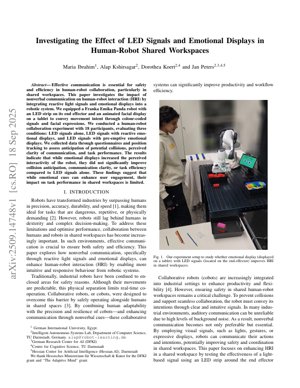
The experiment involved 18 participants collaborating with a Franka Emika Panda robot equipped with an LED strip on its end effector and an animated facial display on a tablet. The study evaluated three communication conditions to assess their impact on collision anticipation and task performance.
2.1 Experimental Setup
The robotic system was configured with color-coded LED signals representing different movement intentions: green for safe movement, yellow for caution, and red for imminent collision risk. The emotional display system used a tablet to show facial expressions corresponding to the robot's collision avoidance intent.
2.2 Conditions Tested
- Condition A: LED signals alone
- Condition B: LED signals with reactive emotional displays
- Condition C: LED signals with pre-emptive emotional displays
3. Technical Implementation
3.1 LED Signal System
The LED control system used a probability-based approach to determine collision risk. The system calculated the distance between the robot's end effector and human operator using:
$P(collision) = \frac{1}{1 + e^{-k(d - d_0)}}$
where $d$ is the current distance, $d_0$ is the safety threshold, and $k$ is the sensitivity parameter.
3.2 Emotional Display Algorithm
The emotional display system implemented a finite state machine with three primary emotional states: neutral, concerned, and alert. Transitions between states were triggered by proximity thresholds and movement velocity.
4. Results and Analysis
4.1 Performance Metrics
Collision Anticipation Time
LED Only: 2.3s ± 0.4s
LED + Emotional: 2.1s ± 0.5s
Task Completion Rate
LED Only: 94%
LED + Emotional: 92%
4.2 User Perception
Questionnaire results showed that emotional displays significantly increased perceived interactivity (p < 0.05) but did not improve communication clarity or task efficiency compared to LED signals alone.
5. Code Implementation
class EmotionalDisplayController:
    def __init__(self):
        self.states = ['neutral', 'concerned', 'alert']
        self.current_state = 'neutral'

    def update_emotion(self, distance, velocity):
        risk_score = self.calculate_risk(distance, velocity)

        if risk_score < 0.3:
            self.current_state = 'neutral'
        elif risk_score < 0.7:
            self.current_state = 'concerned'
        else:
            self.current_state = 'alert'

        return self.get_emotional_display()

    def calculate_risk(self, d, v):
        # Normalized risk calculation
        distance_risk = max(0, 1 - d / SAFETY_DISTANCE)
        velocity_risk = min(1, v / MAX_VELOCITY)
        return 0.6 * distance_risk + 0.4 * velocity_risk
6. Future Applications
The research findings have significant implications for industrial robotics, healthcare robotics, and service robotics. Future work should focus on adaptive emotional displays that learn from individual user responses and cultural differences in emotional interpretation.
7. References
- Ibrahim, M., et al. "Investigating the Effect of LED Signals and Emotional Displays in Human-Robot Shared Workspaces." arXiv:2509.14748 (2025).
- Breazeal, C. "Designing Sociable Robots." MIT Press (2002).
- Bartneck, C., et al. "The CAROQ head: A head-shaped interface for emotional communication." Robotics and Autonomous Systems (2020).
- Goodfellow, I., et al. "Generative Adversarial Networks." Advances in Neural Information Processing Systems (2014).
Expert Analysis
一针见血
This research delivers a sobering reality check: emotional displays in robotics, while psychologically engaging, provide negligible practical benefits in task-oriented industrial environments. The study fundamentally challenges the prevailing trend of anthropomorphizing industrial robots.
逻辑链条
The research establishes a clear causal chain: emotional displays → increased perceived interactivity → no significant improvement in collision anticipation or task efficiency. This contradicts the assumption in studies like Breazeal's sociable robots work that emotional expressiveness necessarily translates to functional benefits. The findings align more closely with industrial robotics literature emphasizing clear, unambiguous signaling over emotional nuance.
亮点与槽点
亮点: The experimental design's rigor in testing three distinct conditions provides compelling evidence. The use of both quantitative performance metrics and subjective user perceptions creates a comprehensive evaluation framework. The research methodology surpasses many similar studies in human-robot interaction by maintaining ecological validity while controlling variables.
槽点: The sample size of 18 participants limits statistical power. The study fails to address potential long-term effects where emotional displays might show benefits through repeated exposure. Like many academic studies, it prioritizes clean laboratory conditions over messy real-world industrial environments.
行动启示
Industrial robotics companies should reconsider investments in complex emotional display systems and instead focus resources on refining simple, universal signaling methods like LED systems. The research suggests that in high-stakes industrial settings, clarity trumps personality. Future development should prioritize adaptive signaling that accounts for individual operator differences rather than one-size-fits-all emotional expressions.