1. Introduction & Overview
Realistic virtual object insertion into images and videos hinges on accurate lighting estimation. The paper "Lighting in Motion: Spatiotemporal HDR Lighting Estimation" introduces LIMO, a novel diffusion-based approach designed to estimate high-dynamic-range (HDR) illumination from monocular video sequences. Unlike prior methods that often address subsets of the problem—such as static global lighting or spatially-varying lighting limited to specific environments—LIMO aims to unify five critical capabilities: spatial grounding, temporal adaptation, accurate HDR luminance prediction, robustness across indoor/outdoor scenes, and generation of plausible high-frequency lighting details.
The core innovation lies in its use of a diffusion model, fine-tuned on a large-scale custom dataset, to predict mirrored and diffuse sphere light probes at multiple exposures for any given 3D position in a scene over time. These predictions are then fused into a single HDR environment map using differentiable rendering.
2. Core Methodology
2.1 Problem Definition & Key Capabilities
The authors define a comprehensive set of requirements for a general-purpose lighting estimation technique:
- Spatial Grounding: Lighting must be predicted for a specific 3D location, accounting for local occlusions and proximity to light sources.
- Temporal Consistency & Variation: The model must handle changes due to camera motion, object movement, and dynamic lighting.
- Full HDR Accuracy: Predictions must span orders of magnitude in luminance, from dim indirect light to bright direct sources.
- Indoor/Outdoor Robustness: Must work for both near-field indoor lighting and distant environmental (outdoor) light.
- Plausible Detail: Should generate realistic high-frequency details for reflections while maintaining accurate low-frequency directional illumination.
2.2 The LIMO Framework
LIMO operates on a sequence of monocular video frames. For each target frame and a user-specified 3D position:
- Depth Estimation: An off-the-shelf monocular depth predictor (e.g., [5]) provides per-pixel depth.
- Geometric Conditioning: The depth map and target 3D position are used to compute novel geometric maps that encode the scene's structure relative to the target point.
- Diffusion-Based Prediction: A pre-trained diffusion model, fine-tuned for this task, takes the RGB image and geometric maps as conditioning. It outputs predictions for both a mirror sphere (capturing high-frequency details and direct light sources) and a diffuse sphere (capturing low-frequency, indirect illumination) at multiple exposure levels.
- HDR Fusion: The multi-exposure predictions are combined into a single, coherent HDR environment map using a differentiable rendering loss that ensures physical consistency.
2.3 Spatial Conditioning with Geometric Maps
A key contribution is the move beyond using depth alone for spatial conditioning. The authors argue depth is insufficient for accurate spatial grounding because it lacks information about the relative position of scene geometry to the target point. They introduce additional geometric maps that likely encode vectors or distances from the target 3D point to surfaces in the scene, providing the model with crucial context about potential occluders and nearby light-contributing surfaces.
3. Technical Implementation
3.1 Diffusion Model Fine-tuning
The paper leverages the powerful prior knowledge embedded in large-scale diffusion models (similar to Stable Diffusion). The model is fine-tuned on a custom dataset of indoor and outdoor scenes paired with ground-truth spatiotemporal light probes. The conditioning input $C$ for the diffusion model $\epsilon_\theta$ is a concatenation of the RGB image $I$, the depth map $D$, and the novel geometric maps $G$: $C = [I, D, G]$. The training objective is the standard denoising score matching loss:
$$L = \mathbb{E}_{t, \mathbf{x}_0, \epsilon} \left[ \| \epsilon - \epsilon_\theta(\sqrt{\bar{\alpha}_t} \mathbf{x}_0 + \sqrt{1-\bar{\alpha}_t} \epsilon, t, C) \|^2 \right]$$
where $\mathbf{x}_0$ is the target light probe image, $t$ is the diffusion timestep, and $\epsilon$ is noise.
3.2 HDR Reconstruction Pipeline
Predicting spheres at different exposures (e.g., low, medium, high) solves the challenge of representing the vast dynamic range of real-world lighting in a single network output. The fusion process aligns these predictions. A differentiable renderer can be used to compute a reconstruction loss between the rendered appearance of a known object under the predicted HDR map and its appearance under the ground-truth HDR map, ensuring the fused map is physically plausible.
3.3 Dataset & Training
The authors created a "large-scale customized dataset" of indoor and outdoor scenes. This likely involves capturing or synthesizing video sequences with synchronized HDR light probe measurements at multiple spatial positions. The scale and diversity of this dataset are critical for the model's generalization across varied lighting conditions.
4. Experimental Results & Evaluation
4.1 Quantitative Metrics & Benchmarks
The paper claims state-of-the-art results for both spatial control and prediction accuracy. Quantitative evaluation likely includes:
- Lighting Accuracy: Metrics like Mean Squared Error (MSE) or Log-MSE between predicted and ground-truth HDR environment maps.
- Relighting Accuracy: Measuring the error when rendering known objects/BRDFs under the predicted vs. ground-truth lighting (e.g., using PSNR or SSIM on the rendered images).
- Spatial Grounding: Comparing predictions at different 3D positions within the same scene to demonstrate correct variation.
Reported Performance Highlights
Claim: State-of-the-art in spatial control and prediction accuracy.
Key Advantage: Unifies five core capabilities where prior works only addressed subsets.
4.2 Qualitative Analysis & Visual Comparisons
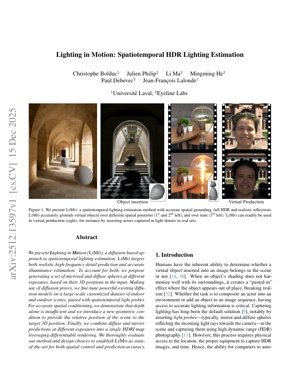
Figure 1 in the PDF demonstrates LIMO's capabilities: 1) Accurate grounding at different spatial positions (objects correctly shaded based on location), 2) Temporal consistency across frames, and 3) Direct application in virtual production by inserting a light-dome-captured actor into a real set with matching lighting. Visual comparisons likely show LIMO generating more realistic high-frequency reflections and more accurate shadow directions compared to baselines.
4.3 Ablation Studies
Ablation studies validate key design choices:
- Geometric Maps vs. Depth Only: Demonstrates the superior spatial grounding achieved by the proposed geometric conditioning over using depth alone.
- Multi-Exposure Prediction: Shows that predicting at multiple exposures is necessary for accurate HDR reconstruction versus predicting a single LDR map.
- Diffusion Prior: Likely compares the fine-tuned diffusion model against a model trained from scratch, highlighting the benefit of leveraging large-scale pre-trained priors.
5. Analysis Framework & Case Study
Core Insight: LIMO isn't just an incremental improvement; it's a paradigm shift towards treating lighting estimation as a generative, spatially-aware, and temporally-coherent reconstruction task. By harnessing diffusion models, it moves beyond regression-based methods that often produce blurry, averaged lighting, capturing the intricate, high-frequency "sparkle" that sells realism—a challenge noted in seminal works on image-based lighting.
Logical Flow: The logic is compelling: 1) The problem is fundamentally under-constrained (infinite lighting solutions can explain an image). 2) Therefore, inject strong priors (diffusion models trained on vast image data). 3) But a global prior isn't enough for local grounding, so add explicit geometric conditioning. 4) HDR is a range problem, so solve it with a multi-exposure strategy. This stepwise addressing of core ambiguities is methodical and effective.
Strengths & Flaws: The strength is its holistic ambition and impressive technical integration. The use of diffusion models is a masterstroke, akin to how CycleGAN leveraged adversarial training for unpaired image translation—it uses the right tool for a generative task. However, the flaw is inherent to its chosen tool: diffusion models are computationally heavy. The inference speed and resource requirements for video-rate processing in real-time applications like AR remain a significant hurdle. The paper's 2025 date suggests this is a forward-looking research piece, not yet an engineered product.
Actionable Insights: For researchers, the clear takeaway is the power of combining generative world models (diffusion) with explicit 3D geometric reasoning. The geometric conditioning maps are a blueprint for other vision tasks requiring spatial understanding. For practitioners in VFX and virtual production, LIMO charts the future: fully automated, on-set lighting estimation that matches the quality of physical light probes. The immediate step is to watch for follow-up work on distillation or specialized architectures to achieve real-time performance, potentially leveraging advancements from organizations like NVIDIA's research on efficient diffusion.
Case Study - Virtual Production Workflow: Consider a scene where a director wants to place a CGI character in a live-action plate of a moving car interior. Traditional methods require manually painting HDRI maps or using inaccurate, static estimations. Using the LIMO framework: 1) The video plate is processed frame-by-frame. 2) For each frame, the 3D seat position is provided. 3) LIMO generates a temporally coherent sequence of HDR lighting maps specific to that seat, capturing the changing sunlight through windows and reflections from the dashboard. 4) The CGI character is rendered under this dynamic lighting, achieving seamless integration without manual intervention.
6. Application Outlook & Future Directions
Immediate Applications:
- Virtual Production & VFX: Automated lighting match for CGI elements in film and television, reducing reliance on physical light probes and manual rotomation.
- Augmented Reality (AR): Realistic shading for virtual objects overlaid on live camera feeds, enhancing immersion.
- Architectural Visualization & Design: Simulating how new furniture or fixtures would look under a room's existing lighting from any viewpoint.
Future Research Directions:
- Efficiency Optimization: Developing faster, distilled versions of the model or leveraging latent diffusion techniques for real-time AR applications.
- Interactive Control: Allowing users to provide weak supervision (e.g., "light source here is brighter") to guide the generation.
- Material & Lighting Decomposition: Extending the framework to jointly estimate scene materials (albedo, roughness) alongside lighting, a classic inverse rendering problem.
- Integration with Neural Radiance Fields (NeRFs): Using LIMO to provide accurate lighting estimates for reconstructing relightable 3D scenes from images.
- Generalization to Unseen Scenes: Further improving robustness across extreme lighting conditions (e.g., night scenes, direct laser light) and more complex geometries.
7. References
- Bolduc, C., Philip, J., Ma, L., He, M., Debevec, P., & Lalonde, J. (2025). Lighting in Motion: Spatiotemporal HDR Lighting Estimation. arXiv preprint arXiv:2512.13597.
- Debevec, P. (1998). Rendering synthetic objects into real scenes: Bridging traditional and image-based graphics with global illumination and high dynamic range photography. Proceedings of SIGGRAPH.
- Ho, J., Jain, A., & Abbeel, P. (2020). Denoising Diffusion Probabilistic Models. Advances in Neural Information Processing Systems.
- Mildenhall, B., Srinivasan, P. P., Tancik, M., Barron, J. T., Ramamoorthi, R., & Ng, R. (2020). NeRF: Representing Scenes as Neural Radiance Fields for View Synthesis. ECCV.
- Ranftl, R., Bochkovskiy, A., & Koltun, V. (2021). Vision Transformers for Dense Prediction. ICCV. (Cited as [5] for depth estimation).
- Zhu, J., Park, T., Isola, P., & Efros, A. A. (2017). Unpaired Image-to-Image Translation using Cycle-Consistent Adversarial Networks. ICCV.
- Gardner, M., et al. (2017). Learning to Predict Indoor Illumination from a Single Image. SIGGRAPH Asia.
- Hold-Geoffroy, Y., Sunkavalli, K., Hadap, S., & Lalonde, J. (2017). Deep Outdoor Illumination Estimation. ICCV.